Mustang Parts
   Carrying Saleen wheels and Bullitt wheels.

Friday, August 19, 2011

Pre-Cruise: Ferndale Police Cars

Some of the police cars in Ferndale.


Pe-Cruise: Ferndale Choppers

I saw this lovely orange chopper in Ferndale.


And this bicycle was neat, too.


Pre-Cruise: Public Safety Fun On Woodward

One of my favorite places to go at Dreamcruise time is the area in Ferndale near city hall, where many interesting police, fire, and EMT vehicles are displayed.


More Pre-Cruise Photos

Some stuff I saw in and around Ferndale today.


Woodward Pre-Cruise: The Focus ST

I took off of work early today and went to Fashionable Ferndale to see if I could find Ford's Focus ST which they were going to show off. Hidden in plain view behind a trailer, and freshly detailed, here it is in its golden glory.


A few observations. I tried to see if I could tell if it has the new REVO knuckle or not, so I took a few undercarriage photos. I'm still not sure, because there wasn't much space to put a camera down there. However, this one is clearly FWD, not AWD as some had hoped.


Some cladding in the way, hard to see the front suspension.
No RWD on this one.

Wednesday, August 17, 2011

California Clean Cars Confusion

In California, an umbrella organization called the California Clean Cars Initiative is advocating ever tougher standards.  It is a coalition of various organizations, including respectable ones such as American Cancer Society and the American Lung Association, and others which are more pollitlcally radical such as The Center for Auto Safety (trial lawyers) and Union of Concerned Scientists.  

And, as usual, Consumers Union joins with the lefties to advocate for unaffordable cars, in opposition to their consumer oriented mission.

One trick that the CCCI pulls is that they conflate "healthy" and "clean" air with "climate change".  I think everyone agrees that smog forming compounds such as NOx and ammonia are dangerous.  The automakers have met every LEV requirement thrown at them, drastically reducing the amount of air pollution from combustion and fuel evaporation.  

However, CO2 is not a carcinogen, and it doesn't form smog or acid rain.  It's plant food.  Hypothetically, a hydrocarbon fuelled vehicle could be designed which would combust its fuel so cleanly, and apply an effective aftertreatment, so that the exhaust would be composed only of CO2, NO2, and H20--complete combustion, with allowance for nitrogen interactions.  However, CCCI would not consider this "clean and healthy" air, because of the global warming lobby.

CCCI would be better off advocating for the removal of dirty-running old cars from California's roads, and going after non-transportation sources such as lawnmowers, boats, and airplanes, if they were serious about the health effects of real pollution.

Yaris Fail

I have not seen the new Toyota Yaris in person yet.  Maybe I'll cross paths with one on Woodward this weekend.  Anyway, looking at the photos and early impressions from other reviewers, I think I can sum it up by quoting Toyota's Yaris tagline. 

"Yaris.   It's A Car."

Or, to quote the ever snarky Car And Driver, "Yep, it's a car. There's not much else to say."

In other words, Toyota is making no effort to build an interesting small car.   They are relying on their reputation for safe, comfortable, reliable cars, and a little bit of styling upate, to try to compete against a very hot small car marketplace.  Meanwhile, Fiat 500 brings style and cute by the bucket.  Ford Fiesta and Mazda2 bring sharp styling and zippy handling.  Honda's Fit brings excellent packaging, good handling, and good fuel economy.  Chevy Rio brings interesting styling and promises strong performance.

So why the capitulation?  The b-car space is going to become more important as fuel economy targets tighten, it seems odd that Toyota would hold back.  If I had to guess, I would say that Toyota was saving its powder for its refresh of its key product, the Camry.

Friday, August 12, 2011

Goodyear's AMT Project

Goodyear is working on an R&D project to design and demonstrate truck tires which maintain their own pressure with some sort of internal pump and valve system.

Goodyear's Air Maintenance Technology (AMT) will enable tires to remain inflated at the optimum pressure without the need for any external pumps or electronics.  All components of the AMT system, including the miniaturized pump, will be fully contained within the tire.
This is an interesting idea, and not totally new, a company called CODA in the Czech Republic has been promoting a design recently which self inflates.

However, the problem with this concept is that it scavenges energy from the tire rotation to pump the air--which will increase rolling resistance.  There is huge pressure on tire makers to reduce rolling resistance as part of fuel economy improvements.  Unless the government somehow gives credit for the technology to reduce the up-front efficiency hit, I don't see automakers being enthusiastic in replacing their old fashioned tires.  That's because fuel economy tests are performed in a lab, and tires are always properly inflated.

Goodyear press release here.

Thursday, August 11, 2011

The Steer Safe: Are The Joking?

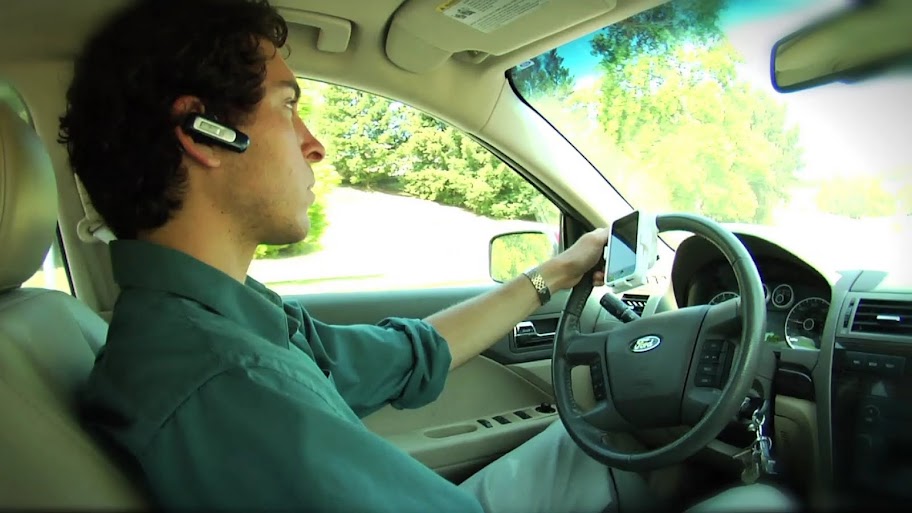
There is a hilariously bad invention up on Kickstarter called Steer Safe which is supposed to help people "safely" use their smartphone while driving, by hanging it from the top of the wheel on a cradle.


Why is this so bad that it is funny?

Well, for one thing, it isn't even remotely "safe". It blocks the drivers view of the vehicles instruments. It encourages fiddling with a touch screen while driving. It may interfere with good hand-to-hand steering. And, perhaps most dangerous of all, it is close to the deployment zone of the driver's airbag.

Can you imagine the damage that thing could do, if you are in an accident with airbag activation? As your body moves forward during the crash, the airbag flap opens violently, flinging a glass and metal smartphone up towards your forehead.

Or in a rear-end accident, your iPhone becomes a projectile, snapping out of its holder and flying towards your face.

This thing is so poorly thought out, I have to believe that they guy posting it is joking. Right?


Review: id America Gasket iPhone Case

id America, a maker of iPhone cases and covers, sent me their Gasket iPhone case to review.

The case is made of brushed aluminum, and is designed to look like an engine block, with cut0uts reminiscent of cylinder bores and cooling passages. In addition to the aluminum shell, the case comes with two clear protectors, for the back and for the front screen. The aluminum shell has a suede inner lining to cushion the phone.


I found the case to fit the phone snugly, and the screen protectors did their job without ruining the usability or feel of the touch screen. Installation was not too hard, though it does take some practice to attach the clear protective film (using the supplied squeegee) without leaving any dreaded air bubbles. Once I had it together, the case felt sturdy and substantial.

Overall, I found the case attractive and effective. I like the automotive inspired design. I would definitely buy one for myself, or as a gift for a fellow gear-head.

The Gasket case can be purchasd from id America here for $30.

Wednesday, August 03, 2011

CAFE: Rise Of The Turbo

One way that automakers will meet the new CAFE standards will be to downsize engines and add turbocharging, as a relatively inexpensive and proven way to get variable displacement. And with direct injection and EGR, the ignition charge can be kept cool, allowing the engine to run highly efficiently on regular octane rating gasoline.

This won't be entirely popular, because even today's low mass, twinned turbos do have some power lag, and they do make different and more annoying noises than a traditional big bore motor. Personally, I would drive a 2.0L gasoline or diesel turbo over a 3.0L naturally aspirated engine, if it would save me 20% or more on fuel, whatever noises it makes.

Another concern about turbos is their durability. I think that Audi, Volvo, Saab, and most recently Ford have proven that modern turbos are robust and can last for the design life of the engine. Ford's "torture test" YouTube series is entertaining, if you want to see a turbo engine severely abused.

The reason turbos help fuel economy is that at low engine load, say when you are cruising down the highway, your engine isn't using much of its power, the turbo isn't really running, and the engine is like a 2.0L I4. However, when you are accelerating, or otherwise making a high power demand, the turbo spools up and allows the engine to consume more air (and fuel), temporarily making it more like the 3.0L V6 you used to drive. Because the EPA fuel economy tests have a good bit of steady state driving, and idling, this variable displacement effect of the turbo really helps the MPG rating.

A smaller turbo engine, all else being equal, will also tend to be lighter weight than a comparable larger engine, which is another source of fuel economy gain.

Since turbos are cheaper than batteries and electric motors, the early CAFE gains are likely to happen through engine downsizing rather than hybridization. The next steps will probably be mild hybrids (start/stop, launch torque) coupled with downsized turbocharged engines.


Engineers: CAFE Won't Be Easy

Wards has published a survey of 1,100 automotive engineers (I am sure I was one respondent) which highlights the trade-offs required to meet the new high CAFE standards.

The best part of the article is some of the comments left in the open ended comment box:

In all, survey respondents left 100 pages worth of comments.

"Consumers don't understand what this will cost, and environmental groups don't care," is a typical comment.

"Aerodynamic blobs on the way," another quips.

Monday, August 01, 2011

The Mighty Have Fallen

Wow.

Consumer Reports, formerly certified fanboys of Honda, have utterly dogged the 2012 Civic. 

It isn't recommended.   Too boring, too plasticky.  

Honda had better be careful.. if they stray too far from their zippy heritage, they are going to get eaten by the very aggressive new up and comers such as Elantra and Focus.

Wednesday, July 27, 2011

The Truth About 60MPG

There is furious lobbying going on, as the automakers and the greens try to sway the Obama administration on future CAFE standards.  The greens, including Consumer Reports, NRDC, and others are claiming that not only is 60MPG feasible, but it will be good for us. Here are some of their main claims.

1)  60MPG will increase jobs and profitability of the Big 3.  Apparently, Citibank looked into a crystal ball and decided that the Big 3 market share and margins would increase with higher fuel economy vehicles.  But the Big 3 rely on large vehicles, even today, for a lot of their profits.  And jobs?  That depends.  If free trade with China continues, I see batteries and other components coming from China, which is a powerhouse in rare earth mining and raw materials processing.  Look at it this way--in the rise of Li-Ion batteries for tools and laptop computers, where are all the parts coming from?  China and Korea.

2) 60MPG will not cost much, and will pay for itself.   True, at $4/gal, a 60MPG car will pay back a sizeable premium in 3-4 years.  However, the cost estimates of some the technology are pie-in-the-sky.  What happens to li-ion battery costs if we start making millions of relatively huge car batteries?  Are the greens ready to strip-mine China for lithium?  What about the supply of rare earth metals for the powerful magnets needed by the motor/generators?   

3) Americans want 60MPG cars.  Sure they do--but they don't want to pay much for them.  As many surveys have shown, when you attach costs to highly efficient cars, interest drops off rapidly.  Today, there are numerous highly efficient small and medium cars available.  However, trucks and SUVs are still hot sellers.   What Americans really want is free efficiency.  They want large cars and cheap gas.  They want fat free french fries.

4)  60MPG is within easy reach, with off the shelf tech.  Sure, for small and mid-sized cars.  Give me a B/C platform and let me add a couple of thousand dollars in engine upgrades, more transmission gears, aluminum and high strength steel components.  You'll have a 60MPG small car that costs $25,000.  Great.  Now, how do you do it for a mid-sized SUV or minivan?  Or the Texas workhorse, the 1-ton pickup?  Not so easy.

Here are some of my thoughts about CAFE standards.

A)  Reducing vehicle weight will reduce overall safety, or add cost due to expensive countermeasures like additional airbags.  It's physics.  In a two car crash, the heavier car does better.  Until all the old heavy vehicles are off of the road, about 10 years after the lightweight ones are introduced, the new vehicles will be at a disadvantage.

B)  High CAFE standards will increase up-front costs, and reduce sales.   Suppose CAFE adds $4,000 in today's money to a typical family vehicle.  Some people will respond by buying used, some will buy smaller or cheaper, and some will defer their purchase.   Yes, you will save money down the road.  But you have to pay the down payment and the taxes now.  I agree with the AAM that sales volumes will be decreased.  Fewer new car sales means fewer jobs in sales and manufacturing.  However, there may be a renaissance in the old car repair industry, as people keep their old beaters longer.

C) High CAFE standards will reduce consumer choice.  How do you make a pickup truck which can pull a 10,000lb trailer, or haul 2,000lbs of bricks in its bed, which gets close to 60MPG?  I don't think it is possible.  Batteries are heavy and reduce payload.  Beefy suspensions and large engines all work against efficiency.  Even with efficiency improvements, in order to be able to sell pickup trucks, the automakers will have to get people to buy smaller cars to offset them.  That's how CAFE works.  The only way to do this is through price manipulation--either lose money on small cars, or jack up margins in large trucks.  Since method one nearly killed the Big 3 once already, I suspect the answer is going to be method two.  People who want muscle cars or pickup trucks will have to pay a lot more for them or do without.  Instead, there will be strong pressure on consumers to pick small cars and range limited EVs.  Products like high-performance sports cars may be very different under a 60MPG regime--slower, more expensive.

So what is the answer?

If you want to influence consumers directly, and do it in a transparent way, you need to tax fossil fuel.  Don't specify a fleet efficiency standard, rather, increase gas taxes slowly until consumers start to respond.  You can make it revenue neutral by rebating the taxes, or offsetting somewhere else.  But there isn't political will to do that.  It's easier to hide behind CAFE.  

Eventually, though, people will notice that CAFE is just another tax, just applied in a more complicated, hidden way.  Unfortunately, it may be too late, after the industry has changed in drastic ways.


Increase performance and gas mileage with a performance chip. Performance Chips Direct sells ECU chips for trucks and cars.

Tuesday, July 26, 2011

Sunday, July 24, 2011

The Ritchie Boys At Holocaust Memorial Center

One of the Detroit area's hidden gems (well, it isn't that hidden) is the Holocaust Memorial Center. A fascinating, if grim, museum of Holocaust history with stunning architecture.

The HMC debuted a new exhibit this last weekend, about the Ritchie Boys, a unit of soldiers who were trained in intelligence gathering and interrogation techniques at the Army's Fort Ritchie, before being sent to Europe to help with the invasion. Many of the Ritchie Boys were Jews who had German language skills.

I went to the opening and shot a few photos.


Out front, a pair of (Brits!) WWII reenactors set up a very nice mini-camp, featuring a lovingly restored Jeep, as well as some excellent replica Browning machine guns, real Garands, and some token barbed wire.


Some old timers

A member of the Jewish War Veterans honor guard


One of the Ritchie Boys, Si Lewen, was an artist and sketched what he saw during the invasion


One of the Ritchie Boys tells his story

One of their misions was propoganda. The would drive around in a truck with a huge amplifier to broadcast German language de-motivation. This was dangerous work, as the Germans would often shoot towards the sound, and they eventually learned to run wires to the speaker some distance away, to draw the fire from the truck.


Paratooper uniform


My favorite part of the exhibit... they should have had more guns. They should have had a Colt 1911 and a Garand, at least.

Infantry uniform


Guy Stern, one of the Ritchie Boys, and also a director of the HMC, speaks about his experience


Class notes from Fort Ritchie, about identifying German weapons and units.


Tools of the trade.

Memorial Flame

A few more Jeep photos


If you haven't gone to the Holocaust Memorial Center, I suggest you take half a day and visit. It is pretty heavy, depressing stuff, but it is a good experience.


The MONOTYPE Car

Designer Fernando Ocana has published a Master's of Art project for an urban vehicle he calls MONOFORM. A 3-person compact city car, his design focuses on how the exterior of the vehicle interacts with the view of the city around it, by using various glass planes to reflect images.


As a pure design project, it is pretty neat. As a vehicle, it is of course unworkable. Rear stearing has inherent stability problems at high speed. Driver visibility in this vehicle doesn't look to be good. There doesn't appear to be any suspension travel. And, probably the most severe issue, the aerodynamics of this shape are probably unworkable.

Would anyone want to drive around in something that looks like a phone booth designed by Lockheed Martin stealth engineers having a bad day?

Green Vehicles RIP

Another one gone, another one gone, another one bites the dust.

Green Vehicles of Salinas CA has closed its doors. They were trying to develop an electric 3-wheeler, the Triac, but after burning through nearly $700,000 in state and local taxpayer funds.

The Triac was supposed to be another one of those rule-dodging vehicles which was considered by regulators to be a motorcycle and not a passenger car, because of its 3 wheel design.

According to the article here, the president of Green Vehicles notified the city of his company's failure via email. Nice.

So whey did the fail? The same reason that Aptera failed, and the same reason that most of the electric start-ups are going to fail. Building a safe, comfortable, reliable, affordable vehicle is not easy, and people are not as willing to experiment with such an expensive purchase as you might think.

When the dust settles, in a few years, I am convinced that the electric vehicles which are successful in the marketplace will come from the established automotive companies, with perhaps a niche player like Fisker or Tesla hanging on.

Despite the arrogant "we can do better" attitude of the start-ups, they are learning that the "old dinosaurs" do know a thing or two about product development and marketing.

Wednesday, July 20, 2011

CR (Still) Hates American Cars

Consumer Reports, which claims to be an impartial advocate for the consumer, to my mind is really a left-leaning organization of dubious intent. CR frequently tells consumers what CR thinks is best for them, rather than primarily taking their interests into account.  Witness their love for socialized medicine and CFL bulbs.  

Today's example, this blog posting from CR on "Best Used Cars Under $20,000"

Several CR staffers submit their choices, and all of them pick Honda or Toyota vehicles, except for two.  There is 1/2 a vote for a Ford Fusion, and 1 vote for a VW.  

Really guys?  You have $20,000 to spend, which is plenty, and you don't even consider some of the better American used vehicles, such as the Ford Escape, Chevrolet Equinox/Saturn Vue, Chevrolet Malibu, Ford Taurus, Chrysler 300?   

Consider: you can get a late model used Malibu or Taurus for under $20,000 which has all the trimmings, including leather heated seats, automatic lights, back up sensors, automatic climate control, etc. 

Tuesday, July 19, 2011

Space Shuttle Joke

Saw this suggestion for a practical joke making the rounds.

"When the Space Shuttle lands, everyone wear ape suits!"

Heh.

Nissan Leaf vs Chevy Volt Pricing

Nissan has announced that it is increasing the price on the 2012 Leaf, by $2,400 over the 2011 model, to $36,000.   Compare that to the price of the Volt, at $40,000.  Nissan also is capped at 20,000 units/year for the U.S. market, while GM has said it plans to produce 60,000 Volts in 2012.

If the Leaf is scarce, dealer markups may continue, reducing the price advantage further.  

Personally, if I was in the market for a plug-in car, I would probably choose the Volt over the Leaf, buying the gasoline hybrid capability for an extra $4,000 or less.

Monday, July 18, 2011

Auto Alliance CAFE Web Site

The Alliance of Automobile Manufacturers has launched a web site to promote the automaker's side of the CAFE debate.  You can find it here.  

Toyota: No Electric RAV4 For You!

According to this source, Toyota will reserve its plug-in RAV4 product (co-produced with Tesla) for fleets and government entities, and won't sell them to the general public.

The Toyota RAV4 EV will make its comeback after first being sold 15 years ago. The vehicle won't be made available to consumers, Yoza said, instead they are focusing on "very strategic applications" such as fleets and car sharing programs. Despite being a BEV that could benefit from fast charging, the RAV4 EV will not include a CHAdeMO charging port. Yoza said Toyota will not offer fast charging on any vehicles until the SAE determines a standard.

 I can hear the shrieking of the BEV boosters all the way from my perch here in Detroit.  "Toyota thinks it's the 1990's!"  Several are probably loading up their super-8 movie cameras in preparation for "Who Killed The Electric Car 2".

Why would Toyota do it this way?  Simple.  Cost.  Chances are the RAV4 EV will be so expensive that Toyota doesn't want to lose a ton of money on them.  Think about the overhead for a new small volume vehicle--dealer training, special service tools, parts distribution.  Instead, by keeping it fleet only, Toyota can keep costs down by centralizing service and support.  

The RAV4 EV is mostly a product for CARB and the "green states" who follow California mandates.  It helps get Toyota the EV points it needs in California, so it can keep selling Tundras (13/17MPG) Sequoias (13/18MPG), FJ Cruisers (15/20MPG) and 4Runners (17/22MPG).   

Wednesday, July 13, 2011

CNG Civic: Cheap Running But Slow

The Honda Civic GX is slated to be sold to retail customers nationally in 2012 (it was only available in four states, previously).  Since it runs on compressed natural gas, it is relatively cheap to run, with CNG fuel economy in the range of 28mpg (EPA estimate) and CNG costing around $1.70/gal.  

However, there are some big trade-offs involved in driving a Civic GX.  Acceleration is poor, with 0-60mph times coming in at 12.6s according to Edmunds.  The range is limited compared to a gasoline powered car, or a Chevy Volt, typically around 200 miles.  And if you want to fuel at home, which is likely because CNG stations are not common, you need to install a CNG compressor which will cost you around $5000, installed.  

Does the Civic GX make more sense than a Chevrolet Volt?  It's a tough call.  The Volt's price (after subsidy) is around $33,000.  The GX price is about $30,000 if you include the cost of the CNG compressor.  For the extra $3,000 you gain the ability to fuel anywhere (if you run it on gasoline or charge at 110v).  CNG miles cost about $.07, while all-electric miles will cost you about $0.06 per mile.  

But the Volt gets to 60mph in about 8.5s, and in range sustaining (gas) mode has a range of over 300 miles.  I think while the government tax credit is in place, I'd take the Volt.

Monday, July 11, 2011

A Couple Evening Car Photos

I went to Woodward to get some ice cream today before sunset. Spotted a few neat cars.

This one appears to be a GM guy driving a late pre-production Chevrolet Caprice.


And this is a tail light of a new Cadillac SRX crossover. It surprised me, the shape of it, I had not noticed it before. It's like a little throwback fin, back to the 1970's.

Carbon Motors, Aptera, VPG, etc.

For a while, it looked like all of the smart kids knew how to make a better car, and how to run the business better than the big boys.  There was a "gold rush" of sorts, as electric car and other niche producers scrambled to set up shop and grab venture capital funding.   

Then the hard economic reality kicked in.   Making cars is hard.  It takes a huge amount of money, people, and time.  And the regulatory hurdles are enormous.

Look at the up-start graveyard.  Bricklin's Visionary Vehicles?  Nowhere.  Mahindra USA?  Limbo at best.  

Aptera is waiting for a federal loan which will probably never come.

So apparently is Carbon Motors, the purpose-built BMW diesel powered police vehicle.  Carbon requested $310,000,000, but is still waiting a year later.  

VPG, maker of a purpose built wheelchair accessible taxi vehicle, apparently got a $50,000,000 loan from DOE to produce a CNG version.  


Survey: U.S. Consumers Unwilling To Pay For CAFE

The Boston Consulting Group, a business consultancy, has issued an interesting report about how automakers can achieve the stringent 2020 fuel economy and CO2 emissions standards without having to resort to electric vehicles.  There is a lot of interesting stuff in there, and as I digest it I'll probably post more about it.

One thing that jumped out at me is this table.  In it, a majority 56% of survey respondents in the U.S. are not willing to pay any premium for an "environmentally friendly car".

And also, consider the odd result for the people who would, if they vehicle would pay for itself.  They are willing to pay up to $3,900 premium, but expect it to pay back in 3 years.  That implies an expected fuel savings of 325 gal/year at $4/gal.  A 27mpg car uses 444 gal/year with a typical 12,000 mile/year driver.  This means people expect the equivalent of going from 27mpg to 100mpg, for $3,900!   Clearly, this is not going to be realistic in any short term time scale. 

The closest vehicle we have now to 100mpg is the Volt, which carries a premium of about $15,000 (compared to a well equipped Cruze).  

So, basically, American consumers are saying, "we'd love fuel efficient cars--as long as they don't cost much (or anything) extra".

Friday, July 08, 2011

CAFE May Cramp High End Luxury Market

An interesting piece in the WSJ, here, expains that luxury car makers such as Porsche and Mercedes may be severely impacted by future CAFE rules.

Future U.S. government fuel economy regulations could saddle auto makers with steep fines or even bar the sale of certain models. Violations of proposed government standards could cost auto makers up to $25,000 a vehicle beginning in 2016, up from current levels of $5 to hundreds of dollars per vehicle.
The issue for the luxury automakers is that CAFE is a fleet average, not a per-car requirement. Large full line carmakers like GM can produce lots of Cruzes to offset a few Cadillac V8's. However, Mercedes doesn't sell enough high MPG vehicles to avoid paying today's fine. And when CAFE marches north of 50mpg average, Mercedes only option is to find some hybrid electric powertrains schnell.

I am not a fan of CAFE because of the way it hides regulation from the consumer, and distorts the car market. However, I don't see why luxury car makers such as Mercedes should be exempt. If CAFE is the regulatory regime, and the goal is to reduce fuel consumption, the luxury car makers should not be allowed to skate.

Now, don't get me wrong, I am not saying that powerful cars should be banned. But I think the wealthy folks who love European luxury cars can afford a "CO2 premium" for their sins. I also admit, bad economic policy aside, that I like the competitive advantage that CAFE gives the full-line automakers such as the Detroit 3.

Friday, July 01, 2011

The Tablet Race?

Somehow, the wizards at Apple figured out that the next big thing in
personal computing was going to be the tablet. Apple's iPad wasn't
even that great of a computer when it first went on sale. They are
great for consuming media (as long as it isn't Flash) but not great
for any sort of intense productive or creative work.

What amazes me is that the very smart people at companies like HP,
Dell, Motorola, and Microsoft were apparently unready to compete.
Only now are credible iPad alternatives appearing, like the Galaxy and
Xoom, but even these are closer to oversized smart phones than general
purpose computers.

Where is Microsoft? Why isn't there a useable Windows edition
optimized for fingertips and not mice?

Now here comes HP, with another tablet OS, based on its (dying) Palm
sourced WebOS.

I think people will settle on two or three systems at most. One may
be Windows, I think, when Microsoft is finally ready. The other will
be Android which has a huge head start over WebOS and RIM's QNX. And
Apples iOS of course is too big to go away.

Me, I about to pull the trigger on an Eee Pad Transformer or maybe an
Iconia, if I can find a nice deal. I want Flash support and a
credible app store.

Thursday, June 30, 2011

Consumer Reports Pushing 62 MPG

One of the reasons I dropped my personal Consumer Reports subscription is that they have become consistently liberal in their outlook, taking the sides of intrusive regulation by the government.

Today CR issues a statement supporting a high (62 MPG) fuel economy.  One of their arguments is that vehicles can be reduced in mass without necessarily becoming less safe.  For small differences in mass, this is probably true. 

Importantly, reducing vehicle mass will be essential in improving fuel economy. Consumer Reports is confident that lighter vehicles will not necessarily compromise vehicle safety. For example, a contemporary family sedan such as the Hyundai Sonata weighs 3,210 pounds and still achieves a Top Safety Pick by the IIHS. It weighs 7.5% less than its previous generation and about 6% less than the average family sedan. By contrast, a Chrysler 200 weighs 3,590 pounds (also a Top-Safety Pick) but with no performance or interior room advantage. The new Honda Civic at 2,810 pounds also received a Top Safety Pick and weighs 400 pounds less (about 9%) than the Chevrolet Cruze, a direct competitor.

However, they make a big mistake here--they refer to IIHS test results between vehicles that are about 400# different.  It is critically important to remember that crash test results such as IIHS and NHTSA, when they are intended to mimic front crashes, simulate a car hitting another car of the same weight.  

What happens when a heavier car hits a lighter car is not pretty.  Here are some great videos by IIHS which make this very point.  Here is the report.

Everything else being equal, heavier cars tend to be safer than lighter cars, and forcing people into lighter cars will, on average, reduce their safety.

Monday, June 27, 2011

Buick Wagon Lust

I can't remember the last time I felt open, unguarded lust about a Buick.  But now GM comes out with a Buick turbo wagon, as if breathing the ghost of Saab back into Buick.  Please tell us, GM, that this lovely piece of rolling practical sculpture will come with manual transmission.


Friday, June 24, 2011

Obama Leaks Some Oil

Obama's energy department yesterday announced it would release 30 million barrels of oil from the Strategic Petroleum Reserve, which holds a total of about 726 million barrels, or about 160 days supply at the maximum withdraw rate of 4.4 million barrels/day.  For reference, U.S. consumption is currently about 20 million barrels/day total, of which about 10 million barrels/day is imported.  

So Obama just spent $12.5 billion (at market prices) to temporarily lower oil prices.  In theory, this will soften the effect of lost Libyan production.  

The problem is, the energy department will have to refill the reserves, buy purchasing the 30 million barrels, or waiting to paid in royalties from oil producers.  

I am not sure if this was a valid use of the SPR, as we should be careful not to blow our oil reserves whenever the price gets high--it should truly be reserved for emergencies.   Loss of production from Libya is not an emergency--it was a foolish policy decision by the U.S. and NATO to go to war with wily Col. Gaddafi.

Wednesday, June 22, 2011

Senate Votes To End Ethanol Tariff

About damn time.  

The ethanol tariff and subsidy were essentially welfare for corn farmers, and perversely, most of the subsidy goes to agricultural giants like Archer Daniels Midland.  

Wednesday, June 15, 2011

Natural Gas to Ethanol

Now here is a form of ethanol production I have no problem with.  Dallas TX based Celanese says it has a process to make ethanol relatively cheaply from natural gas.  

However, because the ethanol is produced from a fossil fuel, it doesn't qualify as a renewable fuel, and therefore can't be used to satisfy the renewable fuel mandates that are driving corn based ethanol.  So unless the law is changed, corn ethanol will continue to drive up food prices and eat tax money.

Tuesday, June 14, 2011

Romney And Ethanol

Mitt Romney, pandering to Iowans, has come out in support of ethanol subsidies.  

I'm going to have a hard time supporting the guy in the primary.

Ethanol subsidies, like other agricultural price supports, are reverse-robin-hood: they take from the poor (us) and give to the mostly rich (large farms and Big Ag).  

Here's an idea: how about we let ethanol follow market forces.  If no one wants the stuff, there will be less produced, and farmers can plant wheat and barley instead, to make proper methanol.

Tuesday, June 07, 2011

GM CEO: Raise The Gas Tax

GM's CEO, Dan "plain speaker" Akerson said in an interview with Detroit News:

"There ought to be a discussion on the cost versus the benefits," he said. "What we are going to do is tax production here, and that will cost us jobs." For the years 2017-25, federal officials are considering 3 percent to 6 percent annual fuel efficiency increases, or 47 mpg to 62 mpg. That could boost the cost of vehicles by up to  3,500. "You know what I'd rather have them do — this will make my Republican friends puke — as gas is going to go down here now, we ought to just slap a 50-cent or a dollar tax on a gallon of gas," Akerson said. "People will start buying more Cruzes and they will start buying less Suburbans."


He is of course, correct: it would be easier to push the market towards buying efficient cars by keeping gas expensive... easier for the carmakers, not for the consumer.  The consumer wants the pain hidden--we want cheap gas and efficient cars (but not too expensive, thank you).  However, the last part of his quote, "People will start buying more Cruzes..." is not what the CEO should really want--GM probably makes a much nicer margin on Suburbans than on Cruzes.   GM's top selling product is still the Silverado/Sierra.

Also, a gas tax now would hurt consumer spending, now, and slow economic recovery--hurting GM's sales. 

Akerson should be careful, he isn't going to win any friends among his customers, or on Wall Street, with so much plain speaking.

Monday, June 06, 2011

GM's Akerson Eulogizes LIncoln

In an uncharacteristically (for GM) blunt statement, GM's CEO said

"They are trying like hell to resurrect Lincoln. Well, I might as well tell you, you might as well sprinkle holy water. It's over," he said about Cadillac's historical competitor."

He's right, of course, that Lincoln is struggling.  

But, he shouldn't be too proud of Cadillac--at 11,600 sales in May of this year, Cadillac is still well behind BMW (20,600) and Mercedes (20,300), and even Lexus (12,300).   

Friday, June 03, 2011

Mazda Manufacturing To Leave US?

According to The Detroit News, an unnamed source is saying that Mazda plans to leave the AAI plant in Flat Rock, MI, which would make Mazda a true import brand once again, with models coming from Japan and Mexico.

I understand that Mazda has a business to run, and that the Mazda6 (a good car) is not a great seller, but I am a little disappointed.  I once owned one of AAI's previous products, the Mazda 626, which was a good handling but cramped mid-sized sedan.  It was fun to point to my "foreign" Mazda and tell people it was assembled in Michigan by UAW labor.