I don't think this guy died, but I do think we need an automotive version of the famous Darwin Awards--people who do the stupidest things, and wind up wrecking their cars.
New Jeep Isnt Trail Rated - Watch more free videos

Carrying Saleen wheels and Bullitt wheels.
Saturday, June 09, 2007
The Fuel Economy Trade-Off Game
| Technology/Technique | Cost | Safety | Convenience | Durability | Fuel Save | Total | Comments |
| Reduce Mass: downsize | +1 | -2 | -2 | 0 | +1 | -2 | Americans like big roomy cars. Safety suffers due to interface with older cars. |
| Reduce Mass: materials | -1 | -1 | 0 | 0 | +1 | -1 | Al, Mg, carbon fiber cost more. |
| Reduce Engine Output | +1 | 0 | -2 | 0 | +1 | 0 | Americans like powerful cars. |
| Mild Hybrid Powertrain | -1 | 0 | 0 | -1 | +1 | -1 | More complexity (batteries, generator) hurts durability. |
| Full Hybrid Powertrain | -2 | 0 | -1 | -1 | +2 | -2 | Even more complexity. |
| Gas Turbo Direct Injection | -1 | 0 | 0 | -1 | +1 | -1 | More complexity. |
| Flex Fuel (Ethanol) | 0 | 0 | -1 | 0 | +1* | 0 (-1) | Fuel availability problems; less gas used, but nearly same carbon output. |
| Passenger Car Diesel | -1 | 0 | 0 | -1 | +2 | 0 | More complexity due to emissions regs. |
| Hydrogen Fuel Cells | -1 | 0 | 0 | +1 | +3 | +3 | Still a research project. |
How do you compare the different ways to increase fuel economy? If you are an engineer, you might make a table which assigns weights to different characteristics and then levels for each one. Combine the numbers, and you have a handy way to compare different choices.
Here is a swag at the fuel economy trade off game, according to my near-expert opinion. The method is to equally weight Cost, Safety, Convenience, Durability, and Fuel Economy. -2 means big decline (more cost, less safety, less convenience, less durability), while a +2 means a big improvement (less cost, more safety, more convenience, etc.). Minus bad, plus good.
So, the way I see it, for a modest fuel savings, the best all around technique is to reduce power, followed by gas turbo direct injection. For large fuel savings, the light diesel seems best. The Holy Grail, as always, is the hydrogen fuel cell.
What is inevitable is that you can't have everything--this is a law of engineering, where physics and economics meet. Want lots of power? Lose weight (and safety). Want safety and fuel economy? Gain cost.
We Americans need to have a serious discussion about what it is we really want, and we need to tell our legislators. What are we willing to give up?
OK, Edmunds just posted a great article which assigns grades to the various fuel saving technologies. You may not believe me, but in fact I was working on the same type of post. I was trying to figure out how to make the table work right.
Sunday, June 03, 2007
Monster Camper Van
The other day, this monster van showed up in one of the parking lots not far from my house. I couldn't help but notice it, and quietly snapped a couple of pictures.


A quick trip to Google, and I learn all about it. The builder is an outfit called Sportsmobile, which starts the process with a Ford or Chevy van or Dodge (Mercedes) Sprinter. Various interior amenities are added, such as a head, beds, mini-kitchen, swiveling chairs, and cabinets. A pop-up camper roof can also be added.
 The example in my neighborhood is a top of the line specimen, as it has been given a Quigley 4x4 conversion in addition to the camper treatment. This van would cost approximately $70,000!
A nice trailer or 5th wheel camper plus a 4x4 truck to tow it seems like a better deal, to me, since you can use the truck for many non-camping activities, and you would have a much larger living space as well. Even if it doesn't make the most sense to me, these monster vans are an impressive product.


A quick trip to Google, and I learn all about it. The builder is an outfit called Sportsmobile, which starts the process with a Ford or Chevy van or Dodge (Mercedes) Sprinter. Various interior amenities are added, such as a head, beds, mini-kitchen, swiveling chairs, and cabinets. A pop-up camper roof can also be added.
The example in my neighborhood is a top of the line specimen, as it has been given a Quigley 4x4 conversion in addition to the camper treatment. This van would cost approximately $70,000!A nice trailer or 5th wheel camper plus a 4x4 truck to tow it seems like a better deal, to me, since you can use the truck for many non-camping activities, and you would have a much larger living space as well. Even if it doesn't make the most sense to me, these monster vans are an impressive product.
Saturday, June 02, 2007
Comparing Cars--SpD
Recently, MotorTrend tested a bunch of high performance cars, and presented the results as spiderwebs, with a combined performance number based on things like steering accuracy, brake feel, roadholding, etc. The result was neat, but not practically useful because it didn't factor in cost.
Then Winding Road got in the game, and proposed the Speed/Dollar index, which is HP/weight/price * fudge factor.
A problem with the SpD metric is that it only cares about power/weight ratio, which can favor cheap cars with big engines, such as the Mustang GT, or even a V8 Chevy family hauler. Nice in a straight line, but what if you are interested in autocross or rallying?
I think a better metric would be something like (HP/Weight + Slalom Speed/60)/Price * K, which would add a dynamic handling component--the speed through a slalom course, in this example. Or perhaps a lap time or average speed around a reference track would be better.
Both Winding Road and Motor Trend put the MazdaSpeed 3 near the top of their list, in terms of bang-for-the buck. Now I want one.
Then Winding Road got in the game, and proposed the Speed/Dollar index, which is HP/weight/price * fudge factor.
A problem with the SpD metric is that it only cares about power/weight ratio, which can favor cheap cars with big engines, such as the Mustang GT, or even a V8 Chevy family hauler. Nice in a straight line, but what if you are interested in autocross or rallying?
I think a better metric would be something like (HP/Weight + Slalom Speed/60)/Price * K, which would add a dynamic handling component--the speed through a slalom course, in this example. Or perhaps a lap time or average speed around a reference track would be better.
Both Winding Road and Motor Trend put the MazdaSpeed 3 near the top of their list, in terms of bang-for-the buck. Now I want one.
Thursday, May 31, 2007
Top Sellers MPG
If the price of gas is such a problem, why don't Americans buy smaller cars? (Answer: because they don't want small cars.)
Here is the list of the 2006 top sellers, by volume, for the U.S. (list courtesy of Edmunds). I have added the average fuel economy numbers from the EPA's 2007 fuel economy list.
Of the top ten best sellers, approximately 2,160,000 units (F150, Silverado, Ram, Impala) get worse than 28mpg (CAFE target is 27.5 for cars). 1,835,100 units (Camry, Accord, Civic, Corolla, Altima, Cobalt) get better than 28mpg.
Here is the list of the 2006 top sellers, by volume, for the U.S. (list courtesy of Edmunds). I have added the average fuel economy numbers from the EPA's 2007 fuel economy list.
1. Ford F-Series (includes F-150, F-250 Super Duty and F-350 Super Duty) — 796,039What I see in these numbers is that the love affair for large vehicles continues, despite fuel costs. Where is the landslide towards small thrifty cars? It isn't here yet.
Fullsize and just plain huge trucks.
Ave. fuel economy: 17mpg (V8 combined City and Highway numbers)
2. Chevrolet Silverado (includes 1500, 1500 Classic, 1500 SS Classic, 1500HD Classic, 2500HD, 2500HD Classic, 3500HD, 3500 Classic — 636,069
Fullsize trucks.
Ave. fuel economy: 17mpg (V8)
3. Toyota Camry and Camry Solara — 448,445
Midsized car.
Ave. fuel economy: 29mpg (I4)
4. Dodge Ram (includes 1500, 2500 and 3500) — 364,177
Fullsized Trucks.
Ave. fuel economy: 17mpg (V8)
5. Honda Accord — 354,441
Midsized Car.
Ave. fuel economy: 29mpg (I4)
6. Honda Civic — 316,638
Compact Car.
Ave. fuel economy: 35mpg
7. Chevrolet Impala — 289,868
Large Car.
Ave. fuel economy: 26mpg
8. Toyota Corolla — 272,327
Compact Car.
Ave. fuel economy: 35mpg
9. Nissan Altima — 232,457
Midsize Car.
Ave fuel economy: 30mpg (I4)
10. Chevrolet Cobalt — 211,449
Compact Car.
Ave fuel economy: 28mpg
Of the top ten best sellers, approximately 2,160,000 units (F150, Silverado, Ram, Impala) get worse than 28mpg (CAFE target is 27.5 for cars). 1,835,100 units (Camry, Accord, Civic, Corolla, Altima, Cobalt) get better than 28mpg.
Wednesday, May 30, 2007
A Response To A Comment
One of my few readers left a comment in my recent post about Bob Lutz' opinion on the cost of raising CAFE standards. His comment was so whacky I thought I'd respond to it point by point. My reply in italics.
Anonymous said...As an engineer myself, I'm quite dubious of your claims. Working in the auto industry as an engineer doesn't necessarily qualify you as a subject matter expert on mileage or CAFE standards or future locomotive technologies or for that matter, of thermodynamics.
Hey, it's my blog, and my opinion. If you think I'm an idiot, start your own blog! Being close to the problems, I think I do have something to say about fuel economy.
Throttling the Big Three on efficiency will drive innovation. Unfortunately, likely not from the Big Three. Unfortunately, your industry is one of the most lackluster at innovation. That includes your foreign competitors. GM has spent over $100 billion in research over the last quarter decade and for that we get .... what? A Chevy Aveo with lower MPG ratings than a Chevette of 1984. Look it up on the government CAFE web site. $100 billion sent a man to the moon and created entire new industries and technologies with the Apollo program. Yes, inflation makes it apples to oranges but....Lackluster? What? Check out all the stuff we have that we didn't in 1984. Airbags. ESC. Seatbelt pretensioners. Rollover sensors. Computer simulated crashes. Self diagnostics of all types. Much of this was not driven by regulation, but by market competition. Do you have any idea how many microprocessors are used in your average car? How many thousands of lines of software code?
As for your Chevette, that is not a valid comparison. How much did that Chevette weigh in 1984? How much horsepower did it have? What was the 0-60mph time? Did the Chevette have power steering, power brakes, side impact beams, front and side airbags, etc., all of which add weight? The lowly Aveo is much more car than a Chevette, in every way.
Innovation will happen in transportation because its now out of your hands. It's in the hands of the world's scientists and entrepreneurs. You may incorporate the technology or with new advances in manufacturing, you may actually see small volume niche players eating your lunch as the landscape of innovation could easily create.I'm not sure what you just said. Many of the world's scientists are working for automotive OEM's and suppliers.
By the way, CAFE standards in Japan and Europe are 2x what they are in the US and China is following suit. Better quit whining and start getting ingenious. Seems like they can sell cars in all three markets for substantially less than the average selling price in the US. Your $5000 claim is meritless. He was talking about America's stringent diesel emissions. Innovation will make that a nonstarter as well just as when Honda embarrassed the Big Three in the 1970s when they said they couldn't meet the emission standards and Honda ended up doing it without a catalytic converter.Where did you get the idea that cars are cheaper in Europe and Japan than in the U.S.? Again, compare apples to apples. The average car in Europe or Japan is a "B" class car--about the size of a Civic or Corolla. That's the family sedan. Very few people can afford a "C" or "D" size car (Accord and larger). Many people drive "A" cars, such as the Smart. Full sized pickup trucks virtually don't exist--here they are the biggest selling vehicles (Silverado, F150).
Why is my $5000 claim meritless? You didn't give any example s of what things cost. Sorry buddy. You need to go back to engineering school. Hey, if you are going to blog, be factual, be honest and expect negative feedback when you are wrong.
Sorry buddy, you need to learn how to argue. If you are going to comment on a blog, and call the blogger out, you had better bring some facts.
Monday, May 28, 2007
Ford Selling Volvo? Why?
According to a news wire story from Reuters, which picked it up from a Swedish newspaper, which got the news from an un-named Ford source, Ford is considering selling Volvo, and BMW is kicking the tires.
Uh, Whiskey Tango Foxtrot?
Ford doesn't report the Volvo financials separately, but the industry guess is that Volvo is probably the most profitable of the Euro-luxury brands. Volvo is also a leader in automotive safety technology, with a valuable portfolio of intellectual property. They are also a leader in environmentally friendly carmaking, another priority for Ford.
Would Ford really keep money-pit Jaguar and sell Volvo? And why would BMW want Volvo, after their sour experience with Land Rover? I am not sure I see how Volvo fits into BMW's portfolio--BMW's cars are sportier, and every bit as safe. They overlap considerably in price.
According to the news article, Ford could gain as much as $9 Billion on a sale of Volvo. That's a nice chunk of change, but then what? Ford would be left with a real hole in their product line-up, with no credible competitor to European luxury brands, with Jaguar being weak and too far upscale and Lincoln not yet a credible threat.
Man, those college professors and Vermont commies are gonna be pissed--BMW isn't what most of them would call a progressive company.
Uh, Whiskey Tango Foxtrot?
Ford doesn't report the Volvo financials separately, but the industry guess is that Volvo is probably the most profitable of the Euro-luxury brands. Volvo is also a leader in automotive safety technology, with a valuable portfolio of intellectual property. They are also a leader in environmentally friendly carmaking, another priority for Ford.
Would Ford really keep money-pit Jaguar and sell Volvo? And why would BMW want Volvo, after their sour experience with Land Rover? I am not sure I see how Volvo fits into BMW's portfolio--BMW's cars are sportier, and every bit as safe. They overlap considerably in price.
According to the news article, Ford could gain as much as $9 Billion on a sale of Volvo. That's a nice chunk of change, but then what? Ford would be left with a real hole in their product line-up, with no credible competitor to European luxury brands, with Jaguar being weak and too far upscale and Lincoln not yet a credible threat.
Man, those college professors and Vermont commies are gonna be pissed--BMW isn't what most of them would call a progressive company.
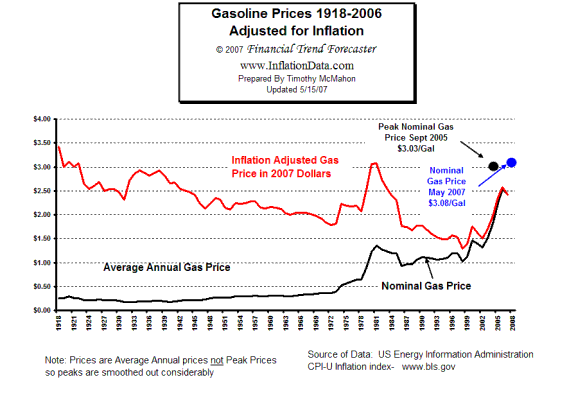
Inflation Adjusted Gas Prices
This chart, from www.InflationData.com , shows the inflation adjusted average annual gas price since the 1920's. What is interesting is the general downward trend since 1920 in the inflation adjusted price, with the exception of the oil embargo of the 1970's and the recent run-up. If the current bump smooths out, according to this trend line we should land somewhere between $2.00/gal in a few years. Or so I hope!
Saturday, May 19, 2007
Shopping the Competition--At The Dealer?
Mark Tapscott comments on his blog about how GM is suggesting to Chevrolet dealers to rent a Toyota Camry to show next to the new Malibu.
Wow, that's ballsy. Good for GM. It could backfire, though--"Look, honey, the Camry has a much nicer..."
Ford was already doing the "taste test" ads where people supposedly like the Fusion better than the Camry or Accord... but putting the competition's car in the showroom takes it to a new level.
Tapscott wants them to go even further, and allow test drives of the main competition, like that insurance company that offers to let you shop the competition on their web site.
I'd be very surprised if that happened. Not just for cost or liability reasons, but what about credibility? Think of how this could be abused--the Chevy dealer could secretly sabotage the Camry, introducing squeeks and rattles, or knocking out the highest gear on the transmission to increase engine noise. If you had a bad Camry experience at a Chevy dealer, would you trust it?
Wow, that's ballsy. Good for GM. It could backfire, though--"Look, honey, the Camry has a much nicer..."
Ford was already doing the "taste test" ads where people supposedly like the Fusion better than the Camry or Accord... but putting the competition's car in the showroom takes it to a new level.
Tapscott wants them to go even further, and allow test drives of the main competition, like that insurance company that offers to let you shop the competition on their web site.
I'd be very surprised if that happened. Not just for cost or liability reasons, but what about credibility? Think of how this could be abused--the Chevy dealer could secretly sabotage the Camry, introducing squeeks and rattles, or knocking out the highest gear on the transmission to increase engine noise. If you had a bad Camry experience at a Chevy dealer, would you trust it?


Ethanol Backlash
There's a good piece here about the rising back-lash against corn-based ethanol mandates. The government is now finding out that mandating more ethanol is putting pressure on corn prices, which has some undesirable unintended consequences. Such as more expensive feed for livestock, which will translate into more expensive meat; more expensive corn syrup, which is the cheap sweetener of choice in just about every commercial food; more planting means more land use and more pesticides.
Those wacky cattlemen.
Once again, a great example of how poorly considered government rule-making can distort the market.
If we really wanted to increase ethanol use, we would drop the tariff on imported ethanol, a whopping $0.54 per gallon. We could then import Brazilian ethanol, which is made more cheaply than our own. But the truth is, the ethanol mandates are mostly a farm lobby pay-off.
Corn ethanol seemed unstoppable, but a remarkable thing happened on the road from Des Moines. Just as the smart people warned, the government's decision to play energy market God and forcibly divert huge amounts of corn stocks into ethanol has played havoc with key sectors of the economy. Corn prices have nearly doubled, which means livestock owners can't afford to feed their animals, and food and drink manufacturers are struggling to buy corn and corn syrup. Environmentalists are sour over new stresses on farmland; international aid groups are moaning that the U.S. is cutting back its charitable food giving, and many of these folks are taking out their anger on Congress.
...
Things are even hotter in Washington, where lobbying groups are firming up their positions against corn ethanol. The hugely influential National Cattlemen's Beef Association has gone so far as to outline a series of public demands, including an end to any government tax credits (subsidies) for ethanol and an axe to the import tariff on foreign ethanol. Put another way, the cattlemen are so angry that they are demanding free markets and free trade--a first.
Those wacky cattlemen.
Once again, a great example of how poorly considered government rule-making can distort the market.
If we really wanted to increase ethanol use, we would drop the tariff on imported ethanol, a whopping $0.54 per gallon. We could then import Brazilian ethanol, which is made more cheaply than our own. But the truth is, the ethanol mandates are mostly a farm lobby pay-off.
Saturday, April 28, 2007
Chelli's Bentley
Yesterday, on Southfield Road, I pulled up next to a shiny black Bentley Azure convertible, like this one:

Driving it, slowly, and chatting on a cell phone was (if I recognized him correctly) Chris Chelios, the senior defenseman from the Red Wings, and owner of Chelli's Chilli Bar restaurants.
It doesn't really matter to me what our local celebrities drive, as I don't care much for celebrity one way or another, but it was neat to see a Red Wing and his wheels.
Driving it, slowly, and chatting on a cell phone was (if I recognized him correctly) Chris Chelios, the senior defenseman from the Red Wings, and owner of Chelli's Chilli Bar restaurants.
It doesn't really matter to me what our local celebrities drive, as I don't care much for celebrity one way or another, but it was neat to see a Red Wing and his wheels.
Sunday, April 22, 2007
Saturday, April 21, 2007
Spotted In Birmingham: Holden Crewman
I stopped by the Border's Books in Birmingham the other day, and found myself parked next to one of these, sporting an M-plate. Sorry for the stolen pics, I dont' have a cell phone camera.


It is a sharp looking car, outside and in. Some lucky engineer from GM probably got to drive it for evaluation purposes.


It is a sharp looking car, outside and in. Some lucky engineer from GM probably got to drive it for evaluation purposes.
Sunday, April 15, 2007
Sometimes, We Need Big Brother
Today, I had a near miss because an idiot in front me of me had exactly one of three brake lamps working. He also had near-black tint on his front windows (technically illegal in MI) and non-functioning hood pins. On a battered Mercedes 200-series!
I would not advocate emissions testing to qualify for vehicle registration, but I am thinking now that mandatory safety inspections may be a good idea.
Should we let people drive with bald tires? Dead brake lamps? Dead headlights? Undamped, bouncing wheels? Worn out brakes? Ridiculously high lift kits that could result in decapitations in a collision with another vehicle?
I'm all for individual freedom, up to the point when people's poor maintenance or poseur engineering endanger the others on the road.
I would not advocate emissions testing to qualify for vehicle registration, but I am thinking now that mandatory safety inspections may be a good idea.
Should we let people drive with bald tires? Dead brake lamps? Dead headlights? Undamped, bouncing wheels? Worn out brakes? Ridiculously high lift kits that could result in decapitations in a collision with another vehicle?
I'm all for individual freedom, up to the point when people's poor maintenance or poseur engineering endanger the others on the road.
Saturday, April 14, 2007
Slip-sliding away, slip-sliding away...
"Domestic" auto sales (Chrysler + Ford + GM) have fallen below 50% market share, and are not likely to recover any time soon, if ever.
But market share doesn't so much matter; the important thing is for the domestics to be sustainable, profitable businesses at the size they wind up at.
How likely is this? It is hard to say. I personally think that GM and Ford are large enough that they might pull itoff, with concessions from the UAW, product updates, and relocating production of low-margin vehicles to low cost countries.
Chrysler, I think, is a tough problem, because they aren't strong enough to stand on their own. Whoever winds up with Chrysler will have to join into alliances with other automakers to keep Chrysler's product pipeline full. If Chrysler's new owner is only interested in making a quick buck, there is a real chance that most of the company will simply evaporate, as the valuable pieces are sold off.
The "elephant in the room" is the massive legacy cost of the pension and retiree health care obligations. These costs mean that the domestics are significantly underwater--for each vehicle they build, they have less money available to put into content. The problem seems intractable, and at some point it will have to be dealt with. Either retirees will be thrown under the bus, or we will see some of the largest bankruptcies in American business history.
Either way, it will be excruciating.
But market share doesn't so much matter; the important thing is for the domestics to be sustainable, profitable businesses at the size they wind up at.
How likely is this? It is hard to say. I personally think that GM and Ford are large enough that they might pull itoff, with concessions from the UAW, product updates, and relocating production of low-margin vehicles to low cost countries.
Chrysler, I think, is a tough problem, because they aren't strong enough to stand on their own. Whoever winds up with Chrysler will have to join into alliances with other automakers to keep Chrysler's product pipeline full. If Chrysler's new owner is only interested in making a quick buck, there is a real chance that most of the company will simply evaporate, as the valuable pieces are sold off.
The "elephant in the room" is the massive legacy cost of the pension and retiree health care obligations. These costs mean that the domestics are significantly underwater--for each vehicle they build, they have less money available to put into content. The problem seems intractable, and at some point it will have to be dealt with. Either retirees will be thrown under the bus, or we will see some of the largest bankruptcies in American business history.
Either way, it will be excruciating.
Monday, April 09, 2007
Where I Buy Volvo Parts
Every now and then, my Volvo breaks in some annoying little way... like the wimpy cupholders that slide out from the console lid, packaged like origami and about as strong.
I have two places that I usually use to buy replacement parts from, and neither one is the local dealer, who has a healthy mark-up on his parts (although they do have nice free breath mints and chocolates at the service counter).
The first is an outfit called FCP Groton, at www.fcpgroton.com. FCP has a good selection of tune-up and wear-out parts for Volvo and a number of other European nameplates. The prices are very good.
The other place I have been dealing with is www.getvolvoparts.com, which is an e-commerce site for an auto dealership in Rhode Island called Tasca Automotive Group. When I needed a secondary air valve recently, Tasca had a great price, and very friendly service. If you need help, you can call or email them and they will support you. Tasca has a very nice online parts catalog, where you can find just about any part on your Volvo.
* I am not being compensated for this plug in any way, I am just a happy customer.
I have two places that I usually use to buy replacement parts from, and neither one is the local dealer, who has a healthy mark-up on his parts (although they do have nice free breath mints and chocolates at the service counter).
The first is an outfit called FCP Groton, at www.fcpgroton.com. FCP has a good selection of tune-up and wear-out parts for Volvo and a number of other European nameplates. The prices are very good.
The other place I have been dealing with is www.getvolvoparts.com, which is an e-commerce site for an auto dealership in Rhode Island called Tasca Automotive Group. When I needed a secondary air valve recently, Tasca had a great price, and very friendly service. If you need help, you can call or email them and they will support you. Tasca has a very nice online parts catalog, where you can find just about any part on your Volvo.
* I am not being compensated for this plug in any way, I am just a happy customer.
Sunday, April 08, 2007
Grindhouse!
 I saw Grindhouse. Loved it. This is a typical Tarantino movie--vulgar, sharp dialog, well crafted. I think they just have used the m-----f---er about 1000 times. The fake movie trailers shown before each half are hilarious.
Tarantino's half of the double feature is "Death Proof", a car chase/revenge story about some stunt-girls who duel it out with a stunt man who gets his kicks stalking pretty girls in his big black muscle car. There is a lot of talking, which you don't mind much because there are four pretty girls doing the talking (interesting somewhat right-wing tangent on gun rights in one scene), followed by a pretty spectacular car chase. The car chase, supposedly was done with "real" cars, no CGI.
If you don't mind sitting through a (pretty funny) disgusting zombie movie to get to the car chase, and don't mind the word "m-----f---er", and understand Tarantino's idea of humor, then definitely go see it, you won't be disappointed.
Friday, April 06, 2007
Bob's $5,000
Bob Lutz recently said that dramatically increasing fuel economy standards could add $5,000 to the price of the average new car.
He's right. This isn't just auto industry doom-saying.
The efficiency of internal combustion engines has plateaued. Every relatively cheap trick that could be used is being used. This includes variable valve timing, high efficiency lubricants, lighter weight materials, higher precision machining, and complex sensor networks and computer controls. And these advancements have added hundreds if not thousands of dollars to the cost of your engine*.
Major leaps forward require large increases in complexity. For example, diesel engines are more expensive because they must be built to withstand high pressures, and need turbochargers for driveability. Hybrid electric drivetrains keep all of the complexity of the existing gas engine, and add in parallel batteries, electric motors, regenerative braking, etc. Even with high-volume production, adding more stuff will always cost more money.
So how can automakers meet high fuel economy standards, without raising the prices dramatically?
The most obvious way is to down-size engines. As recently as the early 1990's, the average family car was packing something like 150HP. Today, a mid-size car with 150HP is considered lame, and 200HP+ is the norm. 0-60 times have likewise been dropping, with 8 second minivans becoming commonplace. But, what will the public say, and especially the automotive press, when the V6 becomes an expensive option, and the I-4 becomes the standard engine?
The other way, which Lutz mentioned, is to pursue ethanol fueled vehicles. Ignoring the problems of producing enough ethanol, for a moment, it is true that E85 uses less fossil fuel because it is by definition 85% ethanol. And by tuning engines specifically to take advantage of ethanol's high knock resistance, by increasing the compression ratio, automakers can overcome the performance hit from the reduced energy content of E85. An example of this technology is Saab's Biopower powertrain.
There is no free lunch. Drastically higher fuel economy will require consumer and taxpayer pain, and compromises. There isn't a 100mpg carburetor sitting on a basement shelf, gathering dust, somewhere in Auburn Hills, Dearborn, or Detroit.
*Ever have to replace an O2 sensor or a secondary air pump? Ouch!
He's right. This isn't just auto industry doom-saying.
The efficiency of internal combustion engines has plateaued. Every relatively cheap trick that could be used is being used. This includes variable valve timing, high efficiency lubricants, lighter weight materials, higher precision machining, and complex sensor networks and computer controls. And these advancements have added hundreds if not thousands of dollars to the cost of your engine*.
Major leaps forward require large increases in complexity. For example, diesel engines are more expensive because they must be built to withstand high pressures, and need turbochargers for driveability. Hybrid electric drivetrains keep all of the complexity of the existing gas engine, and add in parallel batteries, electric motors, regenerative braking, etc. Even with high-volume production, adding more stuff will always cost more money.
So how can automakers meet high fuel economy standards, without raising the prices dramatically?
The most obvious way is to down-size engines. As recently as the early 1990's, the average family car was packing something like 150HP. Today, a mid-size car with 150HP is considered lame, and 200HP+ is the norm. 0-60 times have likewise been dropping, with 8 second minivans becoming commonplace. But, what will the public say, and especially the automotive press, when the V6 becomes an expensive option, and the I-4 becomes the standard engine?
The other way, which Lutz mentioned, is to pursue ethanol fueled vehicles. Ignoring the problems of producing enough ethanol, for a moment, it is true that E85 uses less fossil fuel because it is by definition 85% ethanol. And by tuning engines specifically to take advantage of ethanol's high knock resistance, by increasing the compression ratio, automakers can overcome the performance hit from the reduced energy content of E85. An example of this technology is Saab's Biopower powertrain.
There is no free lunch. Drastically higher fuel economy will require consumer and taxpayer pain, and compromises. There isn't a 100mpg carburetor sitting on a basement shelf, gathering dust, somewhere in Auburn Hills, Dearborn, or Detroit.
*Ever have to replace an O2 sensor or a secondary air pump? Ouch!
B-Class Cars?
 Besides the Flex, the other vehicles that inerest me are the Chevrolet small-car triplet Beat/Trax/Groove. These are fresh and practical looking small cars, which would have as good a chance as any of being a success, if Americans would be willing to buy small cars. (Image courtesy of AutoBlog. Cutie not included)
Which they aren't.
Despite the current meme that Americans are dumping SUVs for cars (only partly true), there is not a groundswell of demand for very small cars. Americans don't want small, fuel efficient cars, they really want cheap gas. Absent cheap gas, they want large cars and mid-size SUVs to replace their large SUVs.
There are some small cars which do well because they fill a specific niche. The Mini, for example, or the upcoming Smart. Others, like the Yaris (son of the abominable Echo) only really appeal to people who can't afford something better, or rental car fleets. Smart, by the way, has not been profitable since its inception in its home market.
On the regulatory side, the new CAFE calculations, which use a vehicle's footprint to calculate fuel economy targets rather than an arbitrary number, should give manufacturers the flexibility to avoid b-cars and concentrate on improving the efficiency of their larger vehicles.
The Ford Flex in NY
 One of the more interesting vehicles to come out of the New York Auto Show is the production intent version of the Ford Fairlane concept "people mover", renamed to Flex. I like it, but I do have the requisite "buts".
Likes:
- Distinct, clean, modern design. Cues from Land Rover, classic station wagons of old, and the "427" theme. I like the white roof. Nice wheel proportions.
- Long wheelbase, lots of room for 2nd row passengers.
- Decent interior design.
- User programmable color lighting.
- Standard electronic stability control and side curtain airbags
- Capless fuel filler, which uses a rotating valve instead of a screw-off cap
- Lock keypad hidden in black b-pillar, with backlit buttons. Slick.
- Sync driver interface with a hard drive for storing MP3s onboard.
- The new aluminum 3.5L V6, 260HP
- The name. "Flex" doesn't strike me as very elegant. It may also confuse some people that the Flex is not a FFV (Flexible Fuel Vehicle). On the other hand, Ford could make a Funk Master Flex edition of the Flex.
- The (predicted) price. Ford hasn't announced a price, but I doubt they will sell this for much less than the mid-range Edge or the Freestyle/Taurus X. I'm betting this will start at just below $30k and will probably option out north of $35,000. Not the most affordable people mover, compared to the basic minivans of yesteryear.
- The optional refrigerator. The cooler is located in the 2nd row, and if purchased will remove the middle seat of the 2nd row. The driver can't reach the cooler in that location. I like Chrysler's cooled glovebox design better.
- The 7th passenger (if the cooler is not installed) appears to sit on a very narrow bench seat, probably only suitable for a kid. This is not true three-across seating, like in a minivan, but more like 2-and-a-half across.
- Suicide doors, like on the concept, would have been neat.
- The center stack design looks rather plain.
- Is this vehicle sufficiently different from a Taurus X (F.K.A. Freestyle)? Will Ford have two very similar vehicles competing for the same buyers?
Subscribe to:
Posts (Atom)