
Carrying Saleen wheels and Bullitt wheels.
Tuesday, December 17, 2013


Monday, December 16, 2013
Tesla Model S and Carwashes
Did you know you are not supposed to take a Tesla S through a normal automatic carwash? And this is the car of the future?
Thursday, December 05, 2013
The 2015 Mustang Design
Ford unwrapped the new 2015 Mustang today, and it is a very handsome car. Personally, I think they struck a good balance between retro styling and the Ford corporate styling, mixing classic Mustang bits with the new Fusion in reasonable proportions.
I did this quickie photoshop to compare the outline of the old and new. You can see the basic proportions are the same, with a long nose and a fastback roofline, and a stubby rear deck. There are some surprises here. The new car is noticeably more compact, which enhances the low-and-wide aspect of its stance. Notice how the hood line is very horizontal, and then has a pronounced curve downward towards the shoulder line, which includes the top edge of the headlamps. On the rear quarter, there is less pronounced of a curve to the shoulder, but the rear pillars seem to move inwards quickly, leaving pronounced horizontal shoulders, which reminds me a bit of the Camaro. Also notice the very vertical front nose profile. And the old "hockey-stick" curve near aft of the doors is gone.
Part of the reason for the pronounced curve of the nose and the very flat front, I think, is probably the aggressive Euro pedestrian protection regs, which require crush space so that pedestrian legs and heads take less damage from car-people collisions.
Overall, I think the 2015 Mustang is a very good design, which balances the needs of style, tradition, and all the other less obvious requirements such as aerodynamics and crash safety. It is more conservative than I personally would have liked, but fresh enough to not look like a rewarmed 2010 model.


Thursday, November 21, 2013
NHTSA Is Not Investigating Tesla At Musks' Request
NHTSA does not initiate investigations on CEO request. NHTSA says they chose to investigate Tesla battery fires independently. Which means, in my view, that Musk was trying to spin in some damage control.
Detroit News:
But NHTSA Administrator David Strickland told a House panel Tuesday that Tesla didn't request an investigation and that the agency had made an independent decision to open an investigation into 13,100 Model S vehicles after two battery fires were reported since early October in the United States.
"Investigations are independent," Strickland told The Detroit News in an interview after the hearing. "We have never — in my recollection, before I got to NHTSA (as a Senate staffer) or as administrator — have actually had an automaker ask for a formal investigation, but it causes a couple of implications: If a manufacturer asks me or asks the agency for a formal investigation, you've already made a determination that you may have a defect that imposes an unreasonable risk to safety. ... I don't think that would ever happen."
From The Detroit News: http://www.detroitnews.com/article/20131119/AUTO01/311190095#ixzz2lJ4MOIFP
Friday, November 08, 2013
Tesla's Fire Problem
I think Tesla has a problem.
There are only about 17,000 Tesla Model S on the roads right now, but there have been 3 fires due to damage to the battery. In two of these cases, it looks like the damage was mostly to the underbelly, and not due to a severe impact to the frame of the car.
In the third case, in Tennessee, the car apparently hit some debris, which caused a fire to start in the front area of the vehicle. If you look at the photos, which I scraped off of the web, there does not appear to be frame damage. In other words, the guy didn't hit another car, or a large stationary object. He hit something small, but it destroyed his Tesla.
By comparison, a gasoline vehicle can run over pretty severe piece of road debris without catching fire.
I wish I had statistics for vehicle fires, caused by driving (not arson, forest fires, etc.), in vehicles less than 2 years old. That would really put the probabilities in focus. I am not sure where to get such data, it is possible that IIHS has it.
In each of these cases, the vehicle is basically destroyed. Even if driver safety is not necessarily an issue, the cost to insure against a battery fire is going to drive up Tesla owner's insurance costs.
If these incidents continue to mount, Tesla is going to have to do several things to protect their business and consumer confidence. They will likely have to add additional shielding to the underside of the car, adding cost and weight, and possibly reducing range. They may also have to increase ride height.


Friday, October 04, 2013
Tesla Valuation
I don't understand Tesla's stock price and valuation. TSLA is trading at about $175/share right now, with a market cap of $21 billion.
So the market is valuing Tesla at about half the value of GM ($52B), and 1.5x the value of Porsche ($13B)
Based on what?
Tesla is emphatically not Apple. Apple rose to become a top 3 player in mobile phones, the top player in tablet computers, and the top player in MP3 gadgets. Apple sells millions of units, and makes money on hardware, software, service, and content.
Tesla has to make money selling cars--a very highly regulated, capital intensive business. Tesla isn't able to sell direct to consumers in all states of the U.S.
Let's compare Tesla to Porsche.
2013 Sales (1st 2 quarters)
Porsche 81,000
Tesla: ~10,000
2013 Revenue:
Porsche: ~$10 billion
Tesla: ~$1 billion
The stock buyers apparently think that Tesla is a growth company, and are pricing in the expectation that it will grow to something quite a bit more profitable than Porsche. In 2012, Porsche recorded a profit of $2.7 billion. To reach those kinds of results, Tesla has to sell approximately 125,000 cars a year (at $80,000 each) if they are making a similar margin to Porsche. If Tesla goes down to an average price of $50,000/car, they have to sell about 200,000 cars/year.
That's about 8x their current capacity of 500 cars / week (25,000/year).
So, the market seems to think that within a few years, Tesla will be able to open several new plants, and successfully increase their sales and distribution network to rival Porsche, while moving downmarket enough to drive higher volumes.
I am doubtful.
Sunday, September 01, 2013
EU Proposes Satellite Based Speed Limiters
A great demonstration of how the Europeans are not necessarily worth emulating. The EU has proposed ISA (intelligent speed adaptation) based on GPS or sign reading cameras, which would first warn a driver and then automatically slow a vehicle down, if they were exceeding local speed limits.
The scheme would work either using satellites, which would communicate limits to cars automatically, or using cameras to read road signs. Drivers can be given a warning of the speed limit, or their speed could be controlled automatically under the new measures.
Something like this would simply be laughed out of Congress in the States. But in Europe, the EU central regulatory agencies have a lot of power, and top-down regulation is a way of life.
Source: Telegraph
Source: Telegraph
Friday, August 30, 2013
Diesels: Good MPG, Less So Carbon
I have heard man advocates of small diesels moan that we "just don't get it" here in the U.S. and we need to be more European, and somehow encourage light duty diesels.
What the compression ignition lovers don't realize is that the U.S. policy is very much now based around global warming and carbon reduction, whereas it used to be about reducing oil consumption for geopolitical reasons (OPEC etc.)
So, let's look at carbon emissions:
1 gallon of gasoline when burned will emit approximately 19.64 pounds of CO2.
1 gallon of diesel will emit approximately 22.38 pounds of CO2.
Diesel is about 14% more carbon emitting than gasoline.
But, a diesel engine is about 30% more fuel efficient than a similarly sized gasoline engine. So if we do the math, a similarly sized diesel powered car will emit about 14% less CO2 than a similar diesel car. Not bad, but not huge.
Meanwhile, diesel fuel offers no advantage in the U.S. in cost (it is more expensive than gasoline by about 30%), and the vehicles cost more due to the diesel hardware premium.
Monday, August 26, 2013
Tesla's Extra 0.4 Star
Tesla is trumpeting the Model S' excellent performance in NHTSA's safety tests. Tesla says that the model S has achieved a combined rating of "5.4 stars":
Palo Alto, CA — Independent testing by the National Highway Traffic Safety Administration (NHTSA) has awarded the Tesla Model S a 5-star safety rating, not just overall, but in every subcategory without exception. Approximately one percent of all cars tested by the federal government achieve 5 stars across the board. NHTSA does not publish a star rating above 5, however safety levels better than 5 stars are captured in the overall Vehicle Safety Score (VSS) provided to manufacturers, where the Model S achieved a new combined record of 5.4 stars.
This is very odd publicity, to me. NHTSA awards star ratings as integers, and 5 stars is the most you can get. A 5 star rating means that you have less than a 10% chance of serious injury in a serious accident, according to NHTSA's statistical model.
You can't get more than 5 stars, awarded by NHTSA.
Tesla is just trying too hard, here, I think. A 5-star result is excellent, and they should proudly publicize it.
Friday, August 16, 2013
Ford's C-Max Debacle Explained
Ford yesterday announced that it was re-stating the fuel economy label of the C-Max hybrid, from 47 city / 47 highway /47 combined to a still very good but not as impressive 45city / 40highway / 43combined. Note the large decline in the highway number.
So what happened? Did Ford cheat the test? Not really.
What happened was that Ford used the Fusion Hybrid test results to certify the C-Max, which they are allowed to do according to EPA regulations. The EPA regs allow manufacturers to certify vehicles as a group if they are in the same weight class and share powertrains.
Here is the EPA's short report on the matter. An excerpt:
Ford based the 2013 Ford C-Max label on testing of the related Ford Fusion hybrid, which has the same engine, transmission and test weight as allowed under EPA regulations. For the vast majority of vehicles this approach would have yielded an appropriate label value for the car, but these new vehicles are more sensitive to small design differences than conventional vehicles because advanced highly efficient vehicles use so little fuel.
In this case, EPA's evaluation found that the C-Max's aerodynamic characteristics resulted in a significant difference in fuel economy from the Fusion hybrid.
Was this intentional, a case of Ford using the higher number for marketing purposes? Or was it a case of simply not knowing that the C-Max would test out so much differently? I have no idea. But I think in the future, Ford and other carmakers are going to be more careful about publishing fuel economy numbers based on assumptions, after this PR disaster.
Thursday, August 15, 2013
Tesla Quality Checking
An interesting insight into Tesla's assembly and delivery process over at Wired, here.
Tesla is testing every car they build with a battery of tests which takes a whopping 5 hours to complete. This compares with the end-of-line testing of a true high volume mass production auto plant, which takes typically several minutes. At the end of the assembly line, the completed car is run on a rolls machine (chassis dyno) which takes the car through an automated test sequence which spot checks the engine, brakes, transmission, and other systems. There are also final visual inspections.
And that's it. In a modern plant, the quality checks and reliability are built into the assembly process and design itself. Most cars fire up at the end of the line and are ready for a consumer to drive them 150,000 miles.
If Toyota, for example, took 5 hours to test and quality check each Lexus they built, they would not be able to produce many cars, and the plant would not make money.
Is Tesla's extensive end-of-line testing due to a lack of confidence in upstream processes and parts?
If Tesla hopes to be a major player, they will need to increase throughput and reduce in-plant time. They won't be able to check each car for 5 hours.
Monday, August 05, 2013
The Chicken Tax--Bad and Good
There is an interesting piece in the Detroit News today about the possible impact of the "Chicken Tax", the 25% import duty on foreign built (exa-NAFTA) pickup trucks. According to "analysts", pickup trucks in the U.S. may have a several thousand dollar premium compared to what they would cost without the protectionist tariff.
The Chicken Tax, like any other protection tariff, has both bad and good effects.The average selling price of full-size pickups has grown at more than twice the rate of the overall industry — cars and trucks combined — since 2005. The average truck sells for more than $40,000, nearly $9,000 more than the average vehicle, according to automotive research firmEdmunds.com. Automakers in recent years have added more luxury items to pickup trucks — and cars, too — so it's difficult to pinpoint how much an uncompetitive market can be attributed to price.
But Jesse Toprak, an analyst for vehicle pricing website TrueCar.com, said in a telephone interview that weak competition in the truck segment results in a "couple-thousand-dollar premium" paid by consumers.
Bad Effects
- Less consumer choice--We can't have the globally built small/midsized pickups that are sold overseas because with a 25% tariff no one would buy them.
- Higher prices--local production is done in part by UAW labor, which is more expensive than overseas labor.
- Foreign retaliation
Good Effects
- Local production means more jobs, and more business in U.S (and NAFTA region). If you add up direct and indirect jobs, thousands of Americans (and Mexicans and Canadians) are employed because of local truck production. Some are unionized but many are not.
- Higher quality pickup trucks. Due to the high cost of entry, only large established players like Toyota and Nissan have the means to set up a local plant to build trucks--so they have to bring high quality, high margin products. Cheap junk won't fly. Marginal brands like Mahindra or Great Wall have a hard time making a business case for low cost products, due to the high barriers of local labor costs and the regulatory environment.
Judging by the sales numbers (number one selling vehicle is F150, followed by Chevrolet Silverado) the higher prices do not seem to hurt pickup truck sales. Trucks have become a luxury good, as much as a work tool, and people are willing to pay $40,000 for a loaded pickup truck.
Thursday, August 01, 2013
Tesla's Hungry Doorhandles
Edmunds discovered that the Tesla S motorized door handles will not detect your fingers if you have them in the way when they want to close--they will pinch your hand.
Tesla, you might want to fix that. Some little kid is going to try it and get hurt.
Tesla, you might want to fix that. Some little kid is going to try it and get hurt.
Top 20 Vehicles June 2013
Here is a list of the top 20 best selling vehicles in the U.S. through JUne, 2013. Data table courtesy of Good Car Bad Car.
Rank | Vehicle | June 2013 YTD | % Change | June 2013 | % Change |
|---|---|---|---|---|---|
#1 | Ford F-Series | 367,486 | + 22.0% | 68,009 | + 23.6% |
#2 | Chevrolet Silverado | 242,586 | + 24.7% | 43,259 | + 28.9% |
#3 | Toyota Camry | 207,626 | - 2.9% | 35,870 | + 11.7% |
#4 | Honda Accord | 186,860 | + 20.4% | 31,677 | + 9.5% |
#5 | Dodge Ram | 170,319 | + 22.9% | 29,644 | + 23.8% |
#6 | Nissan Altima | 167,787 | + 6.8% | 26,904 | + 23.3% |
#7 | Ford Fusion | 161,146 | + 17.8% | 24,313 | - 0.5% |
#8 | Toyota Corolla/Matrix | 158,972 | + 4.8% | 26,458 | - 0.7% |
#9 | Honda Civic | 158,704 | - 2.4% | 29,724 | + 8.1% |
#10 | Ford Escape | 156,626 | + 23.2% | 28,694 | + 0.7% |
#11 | Honda CR-V | 145,763 | - 0.6% | 26,572 | + 14.1% |
#12 | Ford Focus | 134,785 | + 2.6% | 23,144 | + 9.2% |
#13 | Chevrolet Cruze | 133,689 | + 17.4% | 32,871 | + 73.2% |
#14 | Chevrolet Equinox | 126,397 | + 14.0% | 23,645 | + 13.7% |
#15 | Hyundai Elantra | 126,244 | + 29.1% | 22,163 | + 25.5% |
#16 | Chevrolet Malibu | 111,100 | - 21.4% | 21,288 | - 32.2% |
#17 | Hyundai Sonata | 103,010 | - 12.3% | 19,454 | - 7.1% |
#18 | Toyota RAV4 | 101,274 | + 13.2% | 20,540 | + 35.8% |
#19 | Ford Explorer | 101,243 | + 30.0% | 16,597 | + 13.5% |
#19.1 | Ford Explorer | 95,302 | + 25.9% | 15,588 | + 11.2% |
#19.2 | Ford Explorer Police Interceptor | 5941 | + 173% | 1009 | + 67.3% |
#20 | GMC Sierra | 87,633 | + 20.1% | 16,568 | + 32.8% |
Some interesting things going on here.
Full size trucks are still king -- Ford F-series, Chevrolet Silverado, and Dodge Ram are all in the top 5.
Camry, Accord and Altima are the beset selling sedans, but Camry sales are slowing, while Accord and Fusion are accelerating. Could Fusion overtake Altima and break into the top 3 sedans? Malibu is slipping badly, down 21% YTD.
The Ford Escape is charging up the chart, with a 23% YTD gain in sales, and has beat the CR-V, Equinox, and RAV4, the latter by a large margin.
In small cars, Corolla is still king, and Honda Civic seems to be wilting a little. Ford Focus is hanging on, but the big story is the Cruze, with a huge 17% increase.
Another impressive achievement for Ford, the Explorer has cracked the top 20 list (once upon a time it was one of the most popular nameplates in the country), racking up 95,000 retail sales YTD. The Explorer is the only larger SUV in the top 20.
Brands of the top 20: Chevrolet, Ford, Dodge, Honda, Toyota, Nissan, Hyundai, GMC. Notable in its absence is Chrysler, which can't seem to crack the big-volume game.
Corporate prizes in the top 20:
- Ford: 5 vehicles (F-series, Fusion, Escape, Focus, Explorer)
- GM: 5 vehicles (Silverado, Cruze, Equinox, Malibu, Sierra)
- Toyota: 3 (Camry, Corolla, RAv4)
- Honda: 3 (Accord, Civic, CRV)
- Hyundai: 2 (Elantra, Sonata)
- Nissan: 1 (Altima)
- Dodge: 1 (Ram)
Conclusions: Ford and GM are doing great. Toyota is showing some weakness in sales numbers. Chrysler is MIA.
Wednesday, July 24, 2013
GM's eAssist: 25% improvement?
In a recent blog post, GM claims that their eAssist mild hybrid (starter/generator) system is good for an average 25% fuel economy improvement.
I'm not sure how they got this number, it doesn't pass the common sense test for me.
Here are the EPA ratings for the eAssist Malibu vs the 2.5L I4 gasoline Malibu, copied from the EPA's FuelEconomy.gov web site:
I'm not sure how they got this number, it doesn't pass the common sense test for me.
Here are the EPA ratings for the eAssist Malibu vs the 2.5L I4 gasoline Malibu, copied from the EPA's FuelEconomy.gov web site:
2014 Malibu eAssist
City: 25mpg
Highway: 36mpg
Combined: 29mpg
Combined: 29mpg
2014 Malibu 2.0L
City: 21mpg
Highway: 30mpg
Combined: 24mpg
Combined: 24mpg
So, comparing Malibu vs Malibu, by getting the eAssist system, you gain all of 5mpg for the EPA combined number, which is a 20% improvement, not 25%.
And these are EPA numbers! In real life, where people will drive faster than the EPA does, the benefit of eAssist will drop further.
| | ||
|---|---|---|
Tuesday, July 16, 2013
Musk: Batteries Are Expensive
"The biggest single challenge for electric vehicles is affordability." -- Elon Musk
Musk thinks Tesla can produce in "three to four years" an EV which has sufficient range to be broadly practical, which is affordable to a large number of customers.
Which is probably something like a $30,000 vehicle which has a real world range of 200miles or better. Based on the sales numbers of the current crop of 100mile vehicles, which aren't great, I am guessing the range needs to double before the masses really take notice.
But doubling the range of a car like the Leaf will add approx. $10,000 to its price, at current battery costs of approx $500/kWh.
Which is probably something like a $30,000 vehicle which has a real world range of 200miles or better. Based on the sales numbers of the current crop of 100mile vehicles, which aren't great, I am guessing the range needs to double before the masses really take notice.
But doubling the range of a car like the Leaf will add approx. $10,000 to its price, at current battery costs of approx $500/kWh.
So the billion dollar question is, how will Tesla get ~45kWh of batteries for $10,000, leaving them $20,000 for the base vehicle and profit?
Wednesday, June 26, 2013
Spotted: 2014 Corvette Stingray
I saw this M-plate (GM test fleet car) 2014 Corvette Stingray at a local Lowe's.


The interior is a big improvement over the previous car. The exterior design leaves me a little cold--I think it is a bit busy for my taste.
Friday, June 21, 2013
NHTSA Delays Backup Camera Rule
The NHTSA has decided to delay the regulation requiring backup cameras until 2015, announced in a latter to Senator Jay Rockefeller from Ray Lahood. One reason stated was that NHTSA needed more time to study the cost/benefit equation for the backup cameras.
My issue with the proposal is that it will force carmakers to add expensive LCD displays to vehicles which may not already include them, driving up the price of the lower feature vehicles.
If rear ultrasonic sensors are cheaper, I would suggest that method as an acceptable alternative. The backup warning systems have the added benefit of reducing accidents that happen when people aren't careful when reversing the vehicle. In theory, a backup warning mandate would reduce insurance costs.
Source: Bloomberg
Thursday, June 13, 2013
iOS For Your Car?
Apple's recent announcement that they would be working with automakers, including heavyweights GM, Honda, and Hyundia + Kia, to integrate an iOS interface into their dashboard infotainment systems.
Notable in their absence from the announcement were the major automakers Ford, VW, Toyota, Fiat + Chrysler.
I think the holdouts have the right idea. Getting married to Apple's iOS interface means giving up the branding of the infotainment system, and some control over how it behaves. A better approach is to use a system designed to integrate tightly with the vehicle, which has the right interfaces built into it to talk to any smart (or dumb) phone using open standards such as BlueTooth.
According to recent sales numbers, Android and iOS about the split the market in the U.S., and internationally, Android is the runaway winner. Any global automaker that embraces an iOS optimized infotainment system may be making a business error.
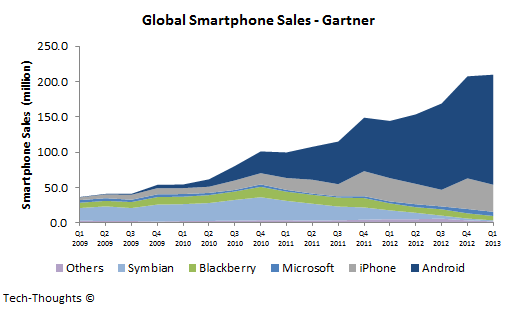
(Graph courtesy of Tech-Thoughts)
Wednesday, June 12, 2013
Should Chrysler Recall The Jeeps?
NHTSA wants Chrysler to recall 2.7 million vehicles to install some kind of crash mitigation hardware on the vehicle to reduce the likelihood of the fuel tank rupturing in a rear end crash.
Should they?
Should they?
On one hand, according to the data, the Jeeps in question are about 2x more likely to leak fuel and catch fire in a rear end crash than other vehicles. NHTSA found that Jeeps were having rear crash fire deaths at a rate of 1 per million miles travelled, while the average for all vehicles is 0.5 fire deaths / million miles.
On the other hand, recalling that many vehicles and repairing them will be a very large task, and very expensive for Chrysler.
On the other hand, recalling that many vehicles and repairing them will be a very large task, and very expensive for Chrysler.
Chrysler rightly argues that its vehicles met all safety standards that were in force at the time they were certified. NHTSA is essentially asking for a retroactive safety recall.
I think a nice middle ground solution might be for Chrysler to develop a retrofit kit, and offer to repair customer vehicles on a request basis. Those who are concerned will get the fix, and those who aren't will not bother. Likely it will be much less than 2.7 million customers.
Subscribe to:
Posts (Atom)