I would like to see automakers and their electronics suppliers join with the MP3 makers and the Bluetooth consortium to develop a standardized automotive interface for personal MP3 players.
I want to be able to get into my car, power up my MP3 player, and have it look like a CD changer to my radio, without needing wires or expensive adapters. I want the MP3 player to stream music to my radio digitally, so that sound quality is preserved, without the static that comes with an FM modulator. The MP3 ID tags should be displayed on the radio as if I was playing an MP3 disc, and I should be able to navigate by folders, songs, artists, etc. Playlists should be supported.
I think that people would be willing to pay little extra for that kind of convenience--I know that I would.
(Steve Jobs is missing the point, when he says people wouldn't want a bluetooth enabled iPod. It wouldn't be for wireless headphones, it would be for streaming your music!)

Carrying Saleen wheels and Bullitt wheels.
Wednesday, September 21, 2005


Monday, September 19, 2005
VW Irrelevant?
Pete DeLorenzo at Auto Extremist says that VW has become irrelevant in the U.S. market.
I agree with him. VW has poor quality, high prices, and perhaps the biggest sin of all--bland styling. They are neither a premium brand, nor a performance brand, nor an economy brand.
I agree with him. VW has poor quality, high prices, and perhaps the biggest sin of all--bland styling. They are neither a premium brand, nor a performance brand, nor an economy brand.
2.70 And Falling
Regular gasoline prices in the Metro Detroit area have drifted down over the last week, from about $3.00/gal to pre-Katrina prices in the neighborhood of $2.60/gal.
What I found amazing was that even when gasoline was selling for $3.15/gal, I still saw lots of people driving their Dodge Durangos, Ford Expeditions, and Chevrolet Avalanches. With no passengers. At 80mph, get the hell out of the way.
For all of the whining that people were doing on the evening news, about how they weren't going to be able to buy as many Christmas presents this year, no one seemed to change their driving habits much. Just slowing down from 75mph to 65mph can give a 10% boost in fuel economy, I have heard*, but people refused to do even that.
Consider: at 65mph, a 15 mile trip will take ~14 minutes. At 75mph, the 15 miles takes 12 minutes.
Would you notice if your drive to work was 2 minutes longer? Most people wouldn't. There is probably at least that much variation day to day based on irregular traffic flow, and variations in when you reach traffic signals.
On the other hand, getting 10% better fuel economy on your morning commute probably isn't that impressive for most people. Assuming 15mpg (the average full-size SUV or maybe a late 90's Chevrolet Impala SS), the difference between 75mph and 65mph might be 0.10 gal, or $0.32 (@ $3.15/gal). Two trips a day for a work-week, and you save one gallon of gas.
20 minutes a week, or $3.15? Which would you rather have?
*Wind resistance increases exponentially with speed.
What I found amazing was that even when gasoline was selling for $3.15/gal, I still saw lots of people driving their Dodge Durangos, Ford Expeditions, and Chevrolet Avalanches. With no passengers. At 80mph, get the hell out of the way.
For all of the whining that people were doing on the evening news, about how they weren't going to be able to buy as many Christmas presents this year, no one seemed to change their driving habits much. Just slowing down from 75mph to 65mph can give a 10% boost in fuel economy, I have heard*, but people refused to do even that.
Consider: at 65mph, a 15 mile trip will take ~14 minutes. At 75mph, the 15 miles takes 12 minutes.
Would you notice if your drive to work was 2 minutes longer? Most people wouldn't. There is probably at least that much variation day to day based on irregular traffic flow, and variations in when you reach traffic signals.
On the other hand, getting 10% better fuel economy on your morning commute probably isn't that impressive for most people. Assuming 15mpg (the average full-size SUV or maybe a late 90's Chevrolet Impala SS), the difference between 75mph and 65mph might be 0.10 gal, or $0.32 (@ $3.15/gal). Two trips a day for a work-week, and you save one gallon of gas.
20 minutes a week, or $3.15? Which would you rather have?
*Wind resistance increases exponentially with speed.
Saturday, September 17, 2005
Details About Volvo ETM Failures
Don Wilson, a retired metallurgical engineer, has posted a detailed analysis of the failures of 1999-2001 Volvo ETMs (Electronic Throttle Modules) at his web site, VexedVolvo. He has photos of a disassembled unit, clearly showing how the resistance film potentiometers wore through, and the wiper contacts picked up debris.

Image courtesy of VexedVolvo.org
Don's conclusion:
(HT: Autoblog)
Image courtesy of VexedVolvo.org
Don's conclusion:
The construction of this potentiometer is obviously not suitable for the application. Considering that in the life of the car there will be multiple millions of cycles of the throttle, the action of the hard metallic finger tips riding on the soft thick film carbon resistor element is a designed-in shortcoming that will result in an estimated 100% or more, failure rate in the life of the Volvo automobile.I am glad that I drive a throttle-by-cable car!
(HT: Autoblog)
Thursday, September 15, 2005
Zeta Confusion
Some time ago, GM announced it was stopping work on the Zeta mid-size-to-fullsize RWD platform, to focus resources on releasing upcoming truck and SUV products.
Then, GM announced that Zeta was coming, after all.
Now, Bob Lutz tells TheCarConnection (near the bottom of the page) that Zeta is looking too expensive to import into the US from Australia.
What interested me about this quote is that there is no mention of whether a version of Zeta would be built in North America for the US market. The implication is that Zeta will not be built in N.A., which of course leads to a question.
What about the Camaro?
I have read on AutoBlog that GM is looking at using one of its other RWD platforms for a Camaro, such as Sigma (Cadillac CTS) or Kappa (Solstice). Kappa doesn't seem likely, as it would have to grow substantially to be a mid-size muscle car. Sigma is said to be expensive.
Then, GM announced that Zeta was coming, after all.
Now, Bob Lutz tells TheCarConnection (near the bottom of the page) that Zeta is looking too expensive to import into the US from Australia.
GM's vice chairman set out to set the record straight on a variety of issues following the Opel reveal on Tuesday. For one thing, he told reporters, the automaker's new rear-drive Zeta platform "is not dead or cancelled." Well, not exactly. The original version was, indeed, scrapped a few months back because "we did a lot of not-smart things…that didn't make business sense. We accepted the delay." As originally planned, GM's Australian subsidiary, Holden, will play the lead in developing the revised Zeta platform. But it is less and less likely that it will be able to export cars based on Zeta, at least to the United States. The Australian dollar's gain on the U.S. dollar "pretty much cancels your profits margin," Lutz lamented, so "exports to the U.S. don't look real promising at this point." But there will still be opportunities for Holden to ship product to other markets, such as the Middle East .
What interested me about this quote is that there is no mention of whether a version of Zeta would be built in North America for the US market. The implication is that Zeta will not be built in N.A., which of course leads to a question.
What about the Camaro?
I have read on AutoBlog that GM is looking at using one of its other RWD platforms for a Camaro, such as Sigma (Cadillac CTS) or Kappa (Solstice). Kappa doesn't seem likely, as it would have to grow substantially to be a mid-size muscle car. Sigma is said to be expensive.
Monday, September 12, 2005
New Jeeps in Frankfurt
Two of the guys behind Autoblog are in Frankfurt, Germany, snapping pictures of the auto show. One of the more interesting photos they grabbed was this image of the Jeep display, showing two new products, the Compass and Patriot.

Image courtesy of AutoBlog
The Patriot is a small SUV which looks very much like a resurrected and refined Cherokee, except that it is apparently build on a car based unibody platform. According to Edmunds, both are built on the same platform as the forthcoming Dodge Caliber, which was a joint development with Mitsubishi to replace the aging Neon. So the Patriot is likely to be front wheel drive/all wheel drive, with independent suspension, very much unlike the solid axles of the old Cherokee. I would be surprised if it came with a low-gear transfer case. I think it looks pretty good, and will be a nice competitor to the Toyota RAV4 and Honda CRV. I also like the name.
With the Compass, however, Jeep has lost its way. It looks like Jeep took a Subaru WRX stud, bred it with a Toyota Matrix mare, and grafted on the nose from a Liberty. In other words, the thing is ugly, and looks much meaner than it will likely actually be, unless Jeep puts a turbo on the 2.0/2.4L engines planned for this platform. I really dislike the way that the Jeep front end looks on a vehicle with tall wagon proportions.

Image courtesy of AutoBlog
Image courtesy of AutoBlog
The Patriot is a small SUV which looks very much like a resurrected and refined Cherokee, except that it is apparently build on a car based unibody platform. According to Edmunds, both are built on the same platform as the forthcoming Dodge Caliber, which was a joint development with Mitsubishi to replace the aging Neon. So the Patriot is likely to be front wheel drive/all wheel drive, with independent suspension, very much unlike the solid axles of the old Cherokee. I would be surprised if it came with a low-gear transfer case. I think it looks pretty good, and will be a nice competitor to the Toyota RAV4 and Honda CRV. I also like the name.
With the Compass, however, Jeep has lost its way. It looks like Jeep took a Subaru WRX stud, bred it with a Toyota Matrix mare, and grafted on the nose from a Liberty. In other words, the thing is ugly, and looks much meaner than it will likely actually be, unless Jeep puts a turbo on the 2.0/2.4L engines planned for this platform. I really dislike the way that the Jeep front end looks on a vehicle with tall wagon proportions.
Image courtesy of AutoBlog
Sunday, September 11, 2005
Diesel Cars in the US
I regularly hear and read claims that there is some industry conspiracy against bringing diesel cars to the US, or that Americans won't buy diesels because of the bad taste left behind by the terrible diesel products of the late 70's.
Both claims are, to use an old fashioned word, bunk. Here is a short explanation of why I think diesels are not being introduced yet.
The most significant engineering problem with using diesel engines in light duty vehicles, at this point, is the EPA and the California Air Resource Board (CARB). The EPA has mandated that light duty vehicles meet very stringent emissions standards, called Tier II. Because of their inherently high NOX emissions, diesels can not (cheaply) meet these emissions standards. Diesels can be made to meet these standards with a few tricks. CARB's rules are even more stringent than EPA's--diesel passenger cars have not been certified for sale in California since 2003.
First, clean diesel fuel is necessary, with low sulfur levels, so that catalysts can be used to change the NOX into N2 and O2. Without low-sulfur diesel, the catalysts get "poisoned" by the sulfur in the fuel, and can not do their job. Cleaner diesel fuel should start showing up at the pumps in 2006.
An alternative to using a precious metals based catalyst for NOX controls is to use urea injection, where the chemical is injected in the hot exhaust stream. GM is proposing to use this system for its pickup trucks, but EPA has not approved it yet, as the system would require the driver to keep a urea tank filled.
The other major diesel emissions issue is particulate emissions, or soot. The current solution is to capture the particulates in a particulate trap oxidation catalyst at lower temperatures, and burn the particulate at high temperatures.
As to the noisiness and hard-to-start legend of diesel passenger cars, the myth would be dispelled the moment that modern diesel engine cars from Europe would be demonstrated here. American's aren't stupid, and we don't have a very long memory (not necessarily a good thing). The real consumer objection to diesel performance is that they are low horsepower, high torque engines. Diesel engines don't like to spin fast (peak power might be at 4000RPM, dropping dramatically at higher speeds). In order to get performance closer to a gasoline engine, diesel engines need to be turbocharged (like the VW TDI), and also may need an intercooler.
Diesel engines, because of their higher internal pressures, and high torque output, need to have much stronger internals then a corresponding gasoline engine. A diesel engine may have a compression ratio of 20:1, compared to a gasoline compression ratio of 10:1. A diesel engine will tend to be heavier than a comparable gas engine.
The problem with diesel engines for light duty passenger vehicles boils down to basically one thing: cost. To have a diesel engine that meets EPA and CARB requirements, you need to have a complicated and expensive dual catalyst or urea injection + catalyst system. You need to have a turbocharger and intercooler. You need a much stronger engine block, crank, pistons, connecting rods, valves, and head. You may wind up with an engine that costs several thousand dollars more than a comparable gasoline engine. At which point, the added cost of the powertrain outweighs the short term fuel savings (like HEVs), and the average consumer has no great incentive to buy a diesel powered car.
If the "value equation" isn't right, there is no way that automakers are going to invest heavily in passenger car diesels.
Both claims are, to use an old fashioned word, bunk. Here is a short explanation of why I think diesels are not being introduced yet.
The most significant engineering problem with using diesel engines in light duty vehicles, at this point, is the EPA and the California Air Resource Board (CARB). The EPA has mandated that light duty vehicles meet very stringent emissions standards, called Tier II. Because of their inherently high NOX emissions, diesels can not (cheaply) meet these emissions standards. Diesels can be made to meet these standards with a few tricks. CARB's rules are even more stringent than EPA's--diesel passenger cars have not been certified for sale in California since 2003.
First, clean diesel fuel is necessary, with low sulfur levels, so that catalysts can be used to change the NOX into N2 and O2. Without low-sulfur diesel, the catalysts get "poisoned" by the sulfur in the fuel, and can not do their job. Cleaner diesel fuel should start showing up at the pumps in 2006.
An alternative to using a precious metals based catalyst for NOX controls is to use urea injection, where the chemical is injected in the hot exhaust stream. GM is proposing to use this system for its pickup trucks, but EPA has not approved it yet, as the system would require the driver to keep a urea tank filled.
The other major diesel emissions issue is particulate emissions, or soot. The current solution is to capture the particulates in a particulate trap oxidation catalyst at lower temperatures, and burn the particulate at high temperatures.
As to the noisiness and hard-to-start legend of diesel passenger cars, the myth would be dispelled the moment that modern diesel engine cars from Europe would be demonstrated here. American's aren't stupid, and we don't have a very long memory (not necessarily a good thing). The real consumer objection to diesel performance is that they are low horsepower, high torque engines. Diesel engines don't like to spin fast (peak power might be at 4000RPM, dropping dramatically at higher speeds). In order to get performance closer to a gasoline engine, diesel engines need to be turbocharged (like the VW TDI), and also may need an intercooler.
Diesel engines, because of their higher internal pressures, and high torque output, need to have much stronger internals then a corresponding gasoline engine. A diesel engine may have a compression ratio of 20:1, compared to a gasoline compression ratio of 10:1. A diesel engine will tend to be heavier than a comparable gas engine.
The problem with diesel engines for light duty passenger vehicles boils down to basically one thing: cost. To have a diesel engine that meets EPA and CARB requirements, you need to have a complicated and expensive dual catalyst or urea injection + catalyst system. You need to have a turbocharger and intercooler. You need a much stronger engine block, crank, pistons, connecting rods, valves, and head. You may wind up with an engine that costs several thousand dollars more than a comparable gasoline engine. At which point, the added cost of the powertrain outweighs the short term fuel savings (like HEVs), and the average consumer has no great incentive to buy a diesel powered car.
If the "value equation" isn't right, there is no way that automakers are going to invest heavily in passenger car diesels.
Wednesday, September 07, 2005
Buyers Be Wary
AutoMuse predicts a flood of flood damaged used cars on the used car market, due to Katrina. She goes on to analyze the legal background of salvage and flood titles. It is possible that some cars will make it onto the market without being clearly marked as being flood damaged.
There is, however, an answer. Carfax. Don't buy a used car that has been registered in the Hurricane ravaged states unless you know its history.
There is, however, an answer. Carfax. Don't buy a used car that has been registered in the Hurricane ravaged states unless you know its history.
Massive Ford Recall (Ouch)
The Reuters news service reports that Ford is recalling 4,000,000 trucks, built between 1994 and 2002 to repair the cruise control deactivation switch. This switch is under NHTSA investigation for underhood fires. The theory for the switch failure is that the brake fluid may be ignited by the switch, which his always hot, if the internal seal fails.
I applaud Ford for doing the right thing, but you can almost hear Ford's investors, dealers, and customers collectively wince, "here we go again".
I applaud Ford for doing the right thing, but you can almost hear Ford's investors, dealers, and customers collectively wince, "here we go again".
Monday, September 05, 2005
New NRA President [Politics]
The new president of the NRA (my favorite political organization), Sandra Froman, is a woman. A Jewish woman.

Sweet.
Sweet.
Gas Tax Economics 201
If any of my (few) readers are knowledgeable about economics, and the economics of gas prices in particular, please chime in.
In support of my earlier post, calling for a temporary suspension of gas taxes, I wanted to explain why I though this would work. I have read a counter-argument that because gasoline is a commodity, it will rise to the pre-tax cut price.
My (admittedly limited) understanding of gas price economics goes like this: There is an international market for oil, price X. Refiners refine the oil into a finished product such as gasoline (or diesel), blend it as necessary, and sell it to retailers at some price, which is X+margin+fuel tax. Retailers get the gasoline, mark it up for retail, and sell it at (x+margin+fuel tax) + retail margin. The core price, X, is set by international demand and market economics, such as speculation. The refined fuel price is set also by refining capacity. The gas pump price is changed mostly by local effects, such as local runs or local competition.
I have heard that the gas station business is a low margin business, and the real money is all made on beer, cigarettes, coffee, and junk food. The primary price mechanism happens at the distributor level.
So my prediction is, that if the federal and state fuel tax applied to the refined product was dropped, the price of gas at the pump would drop by about that amount, unless increased demand caused the refiners to increase the price to the retailers.
In support of my earlier post, calling for a temporary suspension of gas taxes, I wanted to explain why I though this would work. I have read a counter-argument that because gasoline is a commodity, it will rise to the pre-tax cut price.
My (admittedly limited) understanding of gas price economics goes like this: There is an international market for oil, price X. Refiners refine the oil into a finished product such as gasoline (or diesel), blend it as necessary, and sell it to retailers at some price, which is X+margin+fuel tax. Retailers get the gasoline, mark it up for retail, and sell it at (x+margin+fuel tax) + retail margin. The core price, X, is set by international demand and market economics, such as speculation. The refined fuel price is set also by refining capacity. The gas pump price is changed mostly by local effects, such as local runs or local competition.
I have heard that the gas station business is a low margin business, and the real money is all made on beer, cigarettes, coffee, and junk food. The primary price mechanism happens at the distributor level.
So my prediction is, that if the federal and state fuel tax applied to the refined product was dropped, the price of gas at the pump would drop by about that amount, unless increased demand caused the refiners to increase the price to the retailers.
Saturday, September 03, 2005
Wasted Buses [Politics]
This photo shows a yard full of school buses in New Orleans, neatly parked in rows, partly submerged.

Courtesy of Yahoo!
This text is from the City of New Orleans own web page, from the "Comprehensive Plans: Hurricanes" section.
Why are those school buses parked in the city bus yard? Why weren't they used before Katrina hit to get the poor and the sick out of New Orleans?
FEMA may have reacted slowly. But the first line of defense for the people of New Orleans was the city government, and it wasn't ready or wasn't able to meet the challenge.
(HT: JunkYardBlog)
Courtesy of Yahoo!
This text is from the City of New Orleans own web page, from the "Comprehensive Plans: Hurricanes" section.
The City of New Orleans will utilize all available resources to quickly and safely evacuate threatened areas. Those evacuated will be directed to temporary sheltering and feeding facilities as needed. When specific routes of progress are required, evacuees will be directed to those routes. Special arrangements will be made to evacuate persons unable to transport themselves or who require specific life saving assistance. Additional personnel will be recruited to assist in evacuation procedures as needed.The mayor of New Orleans is ranting that George Bush, FEMA, and the military didn't do enough. But according to his own plan, New Orleans officials were supposed to arrange for emergency transportation for "special needs" persons--such as hospital patients, the mentally ill, and the elderly.
Slow developing weather conditions (primarily hurricane) will create increased readiness culminating in an evacuation order 24 hours (12 daylight hours) prior to predicted landfall. Disabled vehicles and debris will be removed from highways so as not to impede evacuation. In local evacuations involving more than fifty (50) families (i.e. 50 single dwelling units), staging areas may be established at the closest available public area outside the threatened area. Upon arrival at the staging area, evacuees will be directed to the appropriate shelter facility. Evacuees will be encouraged to stay with friends or relatives in non-threatened areas whenever possible. Security measures will be employed to protect the evacuated area(s) in accordance with established procedures and situations.
The use of travel-trailers, campers, motorcycles, bicycles, etc., during the evacuation will be allowed so long as the situation permits it. Public information broadcasts will include any prohibitions on their use. Transportation will be provided to those persons requiring public transportation from the area. (See Special Needs Transportation, ESF-1). An orderly return to the evacuated areas will be provided after the Mayor determines the threat to be terminated. Transportation back to the evacuated area after threat termination will be provided as available.
Why are those school buses parked in the city bus yard? Why weren't they used before Katrina hit to get the poor and the sick out of New Orleans?
FEMA may have reacted slowly. But the first line of defense for the people of New Orleans was the city government, and it wasn't ready or wasn't able to meet the challenge.
(HT: JunkYardBlog)
Friday, September 02, 2005
Suspend Gas Taxes
One solution to the (temporarily) out of control gasoline prices: Congress and the state legislatures should immediately pass bills suspending taxes on gasoline. The lost revenue should be categorized as disaster relief spending.
For example, in Louisiana, the state gas tax is 20c/gal. The federal tax is 18.4 c/gal, for a total of 38.4c/gal. (Source: http://www.gaspricewatch.com)
Update: The IRS has reduced the tax on diesel ful, by allowing commercial uses to buy "duty free" diesel intended for farmers and government vehicles. Story here.
For example, in Louisiana, the state gas tax is 20c/gal. The federal tax is 18.4 c/gal, for a total of 38.4c/gal. (Source: http://www.gaspricewatch.com)
Update: The IRS has reduced the tax on diesel ful, by allowing commercial uses to buy "duty free" diesel intended for farmers and government vehicles. Story here.
Wednesday, August 31, 2005
NKOTB
There's a new automotive blog online, eMercedesbenz. Carpundit is suspicious that they may be a plant from DaimlerChrysler, on account of the blog's very professional design, and press-quality photos of Mercedes cars. On the other hand, they may just be very passionate about Mercedes.
Monday, August 29, 2005
Dumbest Mod Ever
I usually save my bile for the huge wings that some TuNeRz put on the back of cars like the Kia Rio. As if the glued on contraption is going to give them downforce at the 45MPH they drive in the suburbs.

But this toy, the Turbo SoundFX, dear reader, takes the effing cake. Why pay $3,500 for a real turbo, when you can stuff this whistle up the tail of your exhaust system, and make your car sound like you have one?
I wonder how many HP you are giving up due to the increased restriction in the exhaust?
But this toy, the Turbo SoundFX, dear reader, takes the effing cake. Why pay $3,500 for a real turbo, when you can stuff this whistle up the tail of your exhaust system, and make your car sound like you have one?
I wonder how many HP you are giving up due to the increased restriction in the exhaust?
Sunday, August 28, 2005
My PermaCap Failure
I bought this gadget for my car some time ago, the PermaCap, which is a replacement for your gas gap. The selling point of the PermaCap is that you don't have to unscrew your gas cap to refuel--you just shove the pump nozzle through the spring loaded door, and pump away.
While it worked, it was great. After several months of use, the PermaCap caused my car to set an evaporative emissions DTC, and turned on my "Check Engine" light. After replacing the PermaCap with my stock gas gap, my code went away and did not return.
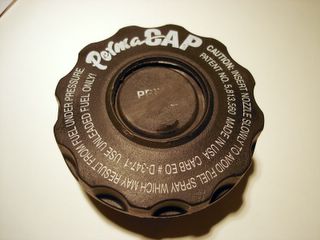
Permacap

Permacap detail, showing the grungy flat rubber sealing ring on the fuel cap door
I suspect that what happened is that the rubber sealing ring on the cap door picked up some grime, which caused a microscopic leak. Today's OBD-II diagnostic systems are required to detect a 0.020" leak in your fuel system. Most of them use a pressure leak-down or bleed-up method: they apply a vacuum to the fuel tank by pumping the fuel vapor out, either with manifold vacuum or an electric pump; or they apply positive pressure with an electric pump.
Kleen Wheels Corp, the maker of the PermaCap, claims a lifetime warranty, so I will see if I can send the cap back for a replacement, and perhaps they will have some advice on how to avoid "Check Engine" lights in the future. I suspect they will tell me that I need to remove and clean the PermaCap once in a while--which would negate most of the value of having such a device to begin with.
I also see that on their web site, they are selling a "new and improved" PermaCap II--so maybe they fixed it?
While it worked, it was great. After several months of use, the PermaCap caused my car to set an evaporative emissions DTC, and turned on my "Check Engine" light. After replacing the PermaCap with my stock gas gap, my code went away and did not return.

Permacap

Permacap detail, showing the grungy flat rubber sealing ring on the fuel cap door
I suspect that what happened is that the rubber sealing ring on the cap door picked up some grime, which caused a microscopic leak. Today's OBD-II diagnostic systems are required to detect a 0.020" leak in your fuel system. Most of them use a pressure leak-down or bleed-up method: they apply a vacuum to the fuel tank by pumping the fuel vapor out, either with manifold vacuum or an electric pump; or they apply positive pressure with an electric pump.
Kleen Wheels Corp, the maker of the PermaCap, claims a lifetime warranty, so I will see if I can send the cap back for a replacement, and perhaps they will have some advice on how to avoid "Check Engine" lights in the future. I suspect they will tell me that I need to remove and clean the PermaCap once in a while--which would negate most of the value of having such a device to begin with.
I also see that on their web site, they are selling a "new and improved" PermaCap II--so maybe they fixed it?
Saturday, August 27, 2005
New CAFE Rules
I haven't had a chance to write a detailed post on the new CAFE rules, but DublinSaab has gone and done a nice job, so I heartily recommend that you go read his.
I love his epithet for greenies, which I have not heard before: "watermellons (green on the outside and red on the inside)".
I love his epithet for greenies, which I have not heard before: "watermellons (green on the outside and red on the inside)".
My Chariot
What do I drive?
Nothing impressive. I drive a Volvo 850 with a 2.4L I-5 engine and a 5 speed manual. ~160HP, 0-60 takes about 9s. I have 100,000+ miles on the car, and I think I will keep it until parts start falling off. I bought the Volvo after college, used, because I wanted a safe, comfortable car with a reliable powertrain. So far it has been exactly that--safe, very ergonomic, but not very exciting.
I haven't done much to the car, except to upgrade the sound system with an MP3 capable head unit and better speakers, and replace worn shocks with better than stock units. I think the car is worth all of $4,000 at this point. I keep toying with the idea of adding an aftermarket turbo kit, and a lowered suspension kit, but I'm too cheap to do it.

Not my actual Volvo, photo courtesy of Edmunds.
What car would I drive if I decided to buy something different?
The new Volvo S40/V50 is a very good car, but it is a little too small for my taste, in the second row. I like the Volvo S60/V70, especially the R versions, but Volvos are fairly expensive to own--when something breaks, you pay out of the nose for it. And, despite Ford's efforts, Volvo is not yet a terribly reliable brand, plagued by electrical problems. I have no problem recommending a Volvo--just be aware that it will not be as cheap to maintain as a Toyota.
Also from Ford, I like the Mazda6 (3.0L V6, manual) and Mazda3 (2.3L I4 manual). The Ford Fusion looks like it might be a good car, but you can't buy on with a V6 and a manual transmission. A 2.3L Fusion with an aftermarket turbo might be fun. I love the design of the Mustang, but I think its muscle-car DNA would annoy me after a while, and I like having 4 doors. A Jaguar X-Type would be a steal, but I am not sure about reliability, and the depreciation would be brutal. Maybe I would buy a used one.
On the GM side, I am oddly attracted to the Chevrolet Cobalt SS--but I would hack off the wing, with prejudice, as soon as I got it home. I also like the Pontiac/Toyota Vibe, especially if I could get a turbo for it. The Pontiac G6 GTP with a manual is high on my list. I would also look at a Cadillac CTS, used. I think the Saab 9-2 ("Saabaru") would be a neat car, as would a Subaru Impreza wagon, despite its bland styling. I also like the Saab 9-3. I fantasize of someday owning a Corvette.
None of Chrysler's cars do anything for me at the moment. The 300 is too gangster for me, and can't be had with a stick. The Charger is interesting, but automatic only. I like the Jeep Grand Cherokee, but I wouldn't drive a large SUV unless it was given to me for free.
Toyota? I won't buy one, for loyalty reasons, but the Scion Tc looks a little like a Volvo, and a great value, so I like it. The rest of Toyotas lineup? Zzzzzzz. Toyota needs to hire some braver stylists.
Honda's Accord coupe is nice, but a little sleepy looking. There is something about the Element's boxy practicality that appeals to me. I really like the Acura TL. Again, loyalty prevents me from buying.
Nissan Altima and Inifiniti G35 are very good cars, with a great powertrains. But they are "the enemy".
My current top 3 picks are Mazda6, Pontiac G6 GTP, Volvo V50. Strange grouping, I agree.
Nothing impressive. I drive a Volvo 850 with a 2.4L I-5 engine and a 5 speed manual. ~160HP, 0-60 takes about 9s. I have 100,000+ miles on the car, and I think I will keep it until parts start falling off. I bought the Volvo after college, used, because I wanted a safe, comfortable car with a reliable powertrain. So far it has been exactly that--safe, very ergonomic, but not very exciting.
I haven't done much to the car, except to upgrade the sound system with an MP3 capable head unit and better speakers, and replace worn shocks with better than stock units. I think the car is worth all of $4,000 at this point. I keep toying with the idea of adding an aftermarket turbo kit, and a lowered suspension kit, but I'm too cheap to do it.
Not my actual Volvo, photo courtesy of Edmunds.
What car would I drive if I decided to buy something different?
The new Volvo S40/V50 is a very good car, but it is a little too small for my taste, in the second row. I like the Volvo S60/V70, especially the R versions, but Volvos are fairly expensive to own--when something breaks, you pay out of the nose for it. And, despite Ford's efforts, Volvo is not yet a terribly reliable brand, plagued by electrical problems. I have no problem recommending a Volvo--just be aware that it will not be as cheap to maintain as a Toyota.
Also from Ford, I like the Mazda6 (3.0L V6, manual) and Mazda3 (2.3L I4 manual). The Ford Fusion looks like it might be a good car, but you can't buy on with a V6 and a manual transmission. A 2.3L Fusion with an aftermarket turbo might be fun. I love the design of the Mustang, but I think its muscle-car DNA would annoy me after a while, and I like having 4 doors. A Jaguar X-Type would be a steal, but I am not sure about reliability, and the depreciation would be brutal. Maybe I would buy a used one.
On the GM side, I am oddly attracted to the Chevrolet Cobalt SS--but I would hack off the wing, with prejudice, as soon as I got it home. I also like the Pontiac/Toyota Vibe, especially if I could get a turbo for it. The Pontiac G6 GTP with a manual is high on my list. I would also look at a Cadillac CTS, used. I think the Saab 9-2 ("Saabaru") would be a neat car, as would a Subaru Impreza wagon, despite its bland styling. I also like the Saab 9-3. I fantasize of someday owning a Corvette.
None of Chrysler's cars do anything for me at the moment. The 300 is too gangster for me, and can't be had with a stick. The Charger is interesting, but automatic only. I like the Jeep Grand Cherokee, but I wouldn't drive a large SUV unless it was given to me for free.
Toyota? I won't buy one, for loyalty reasons, but the Scion Tc looks a little like a Volvo, and a great value, so I like it. The rest of Toyotas lineup? Zzzzzzz. Toyota needs to hire some braver stylists.
Honda's Accord coupe is nice, but a little sleepy looking. There is something about the Element's boxy practicality that appeals to me. I really like the Acura TL. Again, loyalty prevents me from buying.
Nissan Altima and Inifiniti G35 are very good cars, with a great powertrains. But they are "the enemy".
My current top 3 picks are Mazda6, Pontiac G6 GTP, Volvo V50. Strange grouping, I agree.
Wednesday, August 24, 2005
I Get A Noble Ride
"For he on honey-dew hath fed,
And drunk the milk of Paradise."
--Samuel Taylor Coleridge
At the Woodward Dream Cruise, 1G Racing had set up a small area where they were displaying the Noble M12, which they are the importer of, as well as a collection of AC Cobra replicas which they sell.
I stopped and admired the Noble, and spoke to one of the 1G guys about the car. He told me that if I came back Sunday, between 10:00 and 2:00, I may be able to snag a ride in the M12. Of course, I was there the next day, and was actually offered a ride. The driver was an affable Brit who was very happy to talk about the car and its capabilities.

Noble M12 photo from Dream Cruise

Noble M12 Open Bonnet.
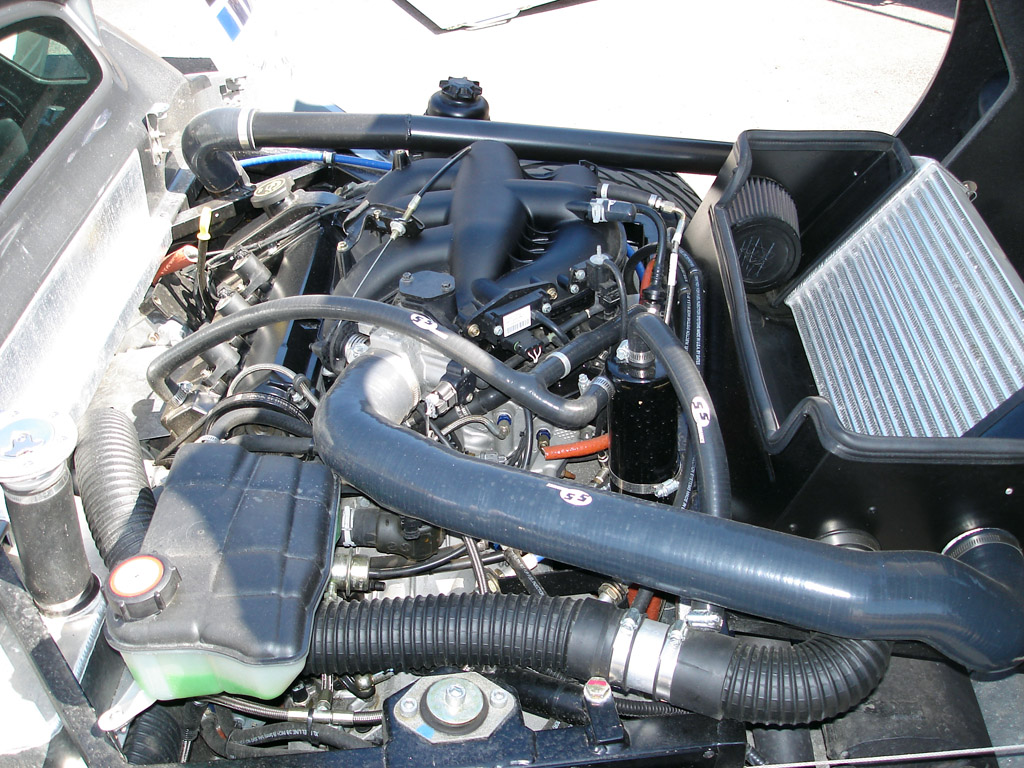
Here you see the AC unit, radiator, and a pair of induction fans to feed the radiator. Note the tubing running from the ports to the radiator. The skin of the car is fiberglass, with some carbon fiber pieces. The frame is welded square tubing.

Noble M12 Engine View.
One of the engine choices for the Noble cars is a Ford Duratech based 3.0L V6, which has been upgraded with forged pistons, retuned cam lift, and a pair of turbos, fed through a massive intercooler. The air intakes are cone type units, visible in the box with the intercooler. This particular setup is rated at 352HP. This is not necessarily supercar territory, until you consider that the M12 weights in at about 2400lbs, yeilding a 6.82 lbs/HP ratio. For reference, the Ford GT's ratio is 6.36 (3500lbs, 550HP); the Ferrari F430's is 6.5 lbs/HP. The M400 model pushes 425HP, for a HP/weight ratio of 5.7 lbs/HP.
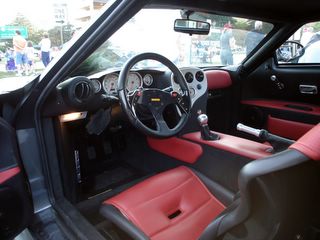
Noble M12 cockpit
The interior of the M12 is spartan and functional, with a few styling touches. The AC vents appear to have been stolen from a Ford product somewhere. The windows are manually cranked, to save weight and complexity. No airbags are installed*. The instruments are spare analog dials, with a few industrial looking red and green lamps aligned vertically on the matte aluminum finish center console. The carpet is a firm synthetic material, with square ridges where the frame crossmembers must be. The seats are non-adjustable racing type seats, firm but supportive, with both street belts and racing belts attached. The seats do slide, of course, and there is more than enough room for a 6' tall driver or passenger. A few red padded panels add some decoration to the interior, but the overall effect is very business-like--this thing was meant to go, not to look like fine Italian leather furniture.

A shot from the passenger seat
My driver started the M12 by pushing the aluminum start button on the console, and wheeled us onto Woodward Ave, northbound. He squeezed the throttle, and the engine spooled up quickly, going from a smooth baritone to an urgent tenor. The engine was loud, but not so loud that I couldn't talk to the driver comfortably without having to shout.
The thrust was amazing--imagine being on a roller coaster, but on level ground. I found myself laughing out loud, giggling like a little kid.
The M12's chassis was solid, with no squeeks, rattles, or other NVH problems that I heard. Road noise was apparent, mostly as vibration through the frame and body panels. The ride was quite firm, but not abusive, considering we were driving on less than smooth Michigan roads. The M12 could be driven as a grocery getter, I suppose, but I wouldn't use it as a commuter car, it is a little too tight for that.
Coming to a red light, my driver applied the brakes firmly, to show off the M12's stopping power. It was obvious, as he tipped out, that the body design and engine tuning was providing plenty of inherent braking. When he applied the brakes, I was shoved into the belt, the braking force was huge.
After an all too short ride, I climbed out of the low slung car with a light head, a real horsepower buzz. "If only I was rich..." The Noble is probably the best street-legal* deal in the super-car realm--about $67,000 for the top of the line M400, fitted with a 425HP powertrain. That's half the price of a Ford GT, and a little less than a Dodge Viper. And, to boot, they are rare--I overheard that currently only 6 cars a month are being imported into the U.S., making them fairly exotic.
There is a (large) downloadable movie of a few laps around a racetrack in a Noble car, with a lovely natural soundtrack, here.
*It is "street legal", but it is technically a kit-car. You are buying a rolling chassis from 1G Racing, only, and then paying for a recommended vendor to install a recommended powertrain; or you could install it yourself. This is because Noble does not have the resources to do a full crash design and testing program, as well as meet the complex California OBD-II software and certification requirements. In this sense, Noble does have an unfair advantage over the manufacturers of complete super-cars.
And drunk the milk of Paradise."
--Samuel Taylor Coleridge
At the Woodward Dream Cruise, 1G Racing had set up a small area where they were displaying the Noble M12, which they are the importer of, as well as a collection of AC Cobra replicas which they sell.
I stopped and admired the Noble, and spoke to one of the 1G guys about the car. He told me that if I came back Sunday, between 10:00 and 2:00, I may be able to snag a ride in the M12. Of course, I was there the next day, and was actually offered a ride. The driver was an affable Brit who was very happy to talk about the car and its capabilities.

Noble M12 photo from Dream Cruise

Noble M12 Open Bonnet.
Here you see the AC unit, radiator, and a pair of induction fans to feed the radiator. Note the tubing running from the ports to the radiator. The skin of the car is fiberglass, with some carbon fiber pieces. The frame is welded square tubing.
Noble M12 Engine View.
One of the engine choices for the Noble cars is a Ford Duratech based 3.0L V6, which has been upgraded with forged pistons, retuned cam lift, and a pair of turbos, fed through a massive intercooler. The air intakes are cone type units, visible in the box with the intercooler. This particular setup is rated at 352HP. This is not necessarily supercar territory, until you consider that the M12 weights in at about 2400lbs, yeilding a 6.82 lbs/HP ratio. For reference, the Ford GT's ratio is 6.36 (3500lbs, 550HP); the Ferrari F430's is 6.5 lbs/HP. The M400 model pushes 425HP, for a HP/weight ratio of 5.7 lbs/HP.

Noble M12 cockpit
The interior of the M12 is spartan and functional, with a few styling touches. The AC vents appear to have been stolen from a Ford product somewhere. The windows are manually cranked, to save weight and complexity. No airbags are installed*. The instruments are spare analog dials, with a few industrial looking red and green lamps aligned vertically on the matte aluminum finish center console. The carpet is a firm synthetic material, with square ridges where the frame crossmembers must be. The seats are non-adjustable racing type seats, firm but supportive, with both street belts and racing belts attached. The seats do slide, of course, and there is more than enough room for a 6' tall driver or passenger. A few red padded panels add some decoration to the interior, but the overall effect is very business-like--this thing was meant to go, not to look like fine Italian leather furniture.
A shot from the passenger seat
My driver started the M12 by pushing the aluminum start button on the console, and wheeled us onto Woodward Ave, northbound. He squeezed the throttle, and the engine spooled up quickly, going from a smooth baritone to an urgent tenor. The engine was loud, but not so loud that I couldn't talk to the driver comfortably without having to shout.
The thrust was amazing--imagine being on a roller coaster, but on level ground. I found myself laughing out loud, giggling like a little kid.
The M12's chassis was solid, with no squeeks, rattles, or other NVH problems that I heard. Road noise was apparent, mostly as vibration through the frame and body panels. The ride was quite firm, but not abusive, considering we were driving on less than smooth Michigan roads. The M12 could be driven as a grocery getter, I suppose, but I wouldn't use it as a commuter car, it is a little too tight for that.
Coming to a red light, my driver applied the brakes firmly, to show off the M12's stopping power. It was obvious, as he tipped out, that the body design and engine tuning was providing plenty of inherent braking. When he applied the brakes, I was shoved into the belt, the braking force was huge.
After an all too short ride, I climbed out of the low slung car with a light head, a real horsepower buzz. "If only I was rich..." The Noble is probably the best street-legal* deal in the super-car realm--about $67,000 for the top of the line M400, fitted with a 425HP powertrain. That's half the price of a Ford GT, and a little less than a Dodge Viper. And, to boot, they are rare--I overheard that currently only 6 cars a month are being imported into the U.S., making them fairly exotic.
There is a (large) downloadable movie of a few laps around a racetrack in a Noble car, with a lovely natural soundtrack, here.
*It is "street legal", but it is technically a kit-car. You are buying a rolling chassis from 1G Racing, only, and then paying for a recommended vendor to install a recommended powertrain; or you could install it yourself. This is because Noble does not have the resources to do a full crash design and testing program, as well as meet the complex California OBD-II software and certification requirements. In this sense, Noble does have an unfair advantage over the manufacturers of complete super-cars.
Tuesday, August 23, 2005
Photos from the Ford NASCAR Event
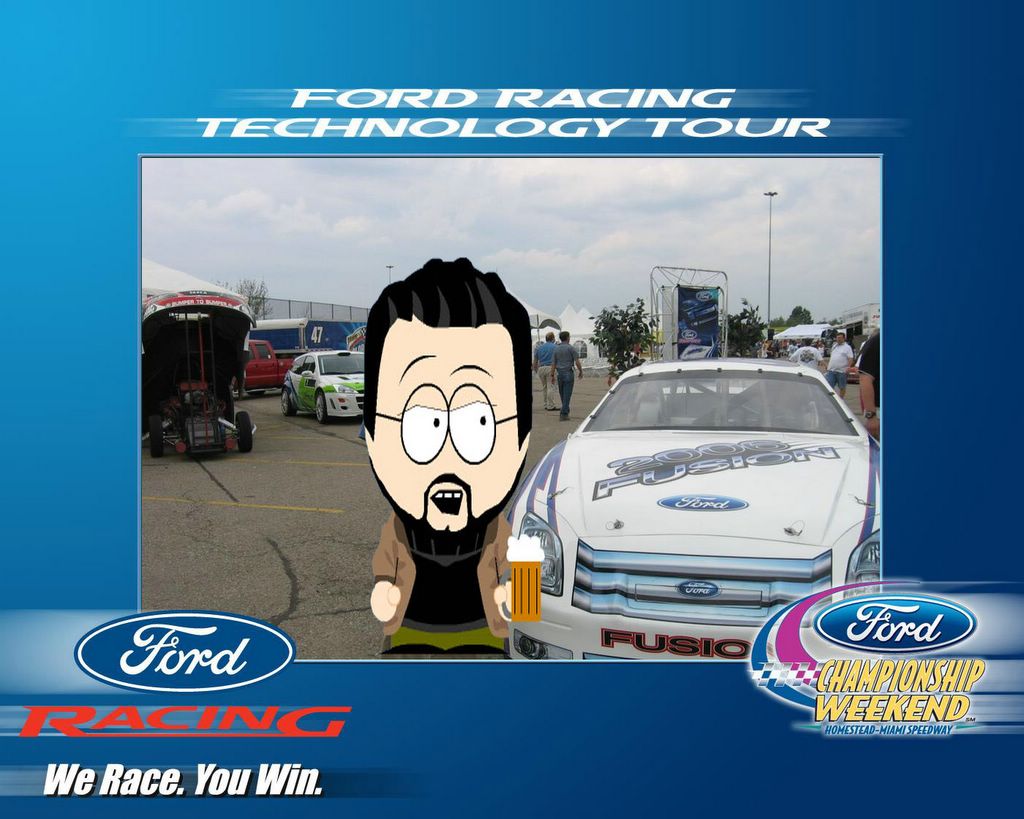
Here are the free photos that I was sent from my visit to the Ford Racing Tech Tour, aka Fusion test drive and NASCAR jubilee. See my previous post, "Flogged a Fusion".
Sorry for the photoshop job, but I have my image to maintain! :-)

Standing by the Focus rally car

A view of the Fusion NASCAR car
Sorry for the photoshop job, but I have my image to maintain! :-)

Standing by the Focus rally car
A view of the Fusion NASCAR car
Subscribe to:
Posts (Atom)