Mustang Parts
   Carrying Saleen wheels and Bullitt wheels.

Monday, August 20, 2007

Cheap Insurance: Gerber Seat Belt Cutter

After the Minneapolis bridge collapse, my wife asked me if we could get some seat belt cutters "just in case". She wanted some extra confidence, in case she was ever trapped in her car, or needed to help someone else out.

I did a Google search, and found a very nice tool made by Gerber, which also makes the excellent Multi Plier multi-tool (second only to the high end Leatherman tools). Amazon sells it (here) for a very reasonable $5 plus shipping.


The knife has a simple and easy to use design, with a cutting hook on one end, made from two opposed straight blades, a body made of tough black plastic, and a nylon lanyard at the other end. To use it, you hook the cutting end over a seatbelt and pull, drawing the two blades through the fabric.

Once you get one of these, another important consideration is where to keep it. If it is in your trunk, or the back of your glovebox, it won't do you much good. A better way to keep it is to use duct tape or velcro tape to affix the cutter to the underside of the driver's seat, or a similar out of the way surface, where you can grab it quickly and easily.

Will you ever need a seat belt cutter? Probably and hopefully not. But for $5, it is a cheap bit of extra insurance.

P.S. I also keep a center punch, to easily break safety glass with. $10 at any hardware store.

Sunday, August 19, 2007

A Few Dream Cruise Photos

I went to the Woodward Dream Cruise late, when it was starting to rain, and didn't really see much that was all that new or exciting. There were lots and lots of 60's and 70's muscle cars, which get old after a few minutes. Here are a few photos I grabbed.

A carefully restored 1965 Volvo. With Arabic script on the rear window.


A not yet carefully restored Volvo.


This dog was posing in front of his owner's hot-rod.


The street preachers took up shop outside the Hall Of
The Mountain King, near some Avantis.


Near the Ford area, some Edsels (still ugly after all these years).
In the upper right is an experimental hydrogen fuel cell powered Edge.


This horned monster truck was cruising through the
Birmingham shopping district. Too much, dude, too much.


A segway nerd scoots past a non-plussed Oakland County sheriff.

The Dream Cruise experience was under-whelming. Too many muscle cars, not enough really old cars. I did see a restored deuce-and-a-half WWII vintage truck cruising around, which was neat. There was also a cube van plastered with huge photos of dismembered fetuses, to protest abortion, which was not. I am pro-life, but man, don't rub it in my face like that. There were a lot of for sale signs on cars--if you were in the market for an expensive toy, you could have done very well at the Dream Cruise this year.

Monday, July 30, 2007

Scoring SCORE

In an article in their vehicles section, Forbes online published a list of the least safe 20 vehicles, ranked according to the Statisical Combination Of Risk Elements (SCORE) metric. The SCORE metric is published by an organization called Informed For Life (which I have not heard of before), and is an attempt to rate how safe a vehicle is by combining various statistics into one number.

I have some reservations about the usefulness of the SCORE metric, however, because it doesn't really correlate that well with actual driver death rates, as published by the IIHS.

Here is a plot published by IFL which claims to show the correlation between the SCORE an driver death rates per million registered years:


What you might notice right away is the large spread of SCORE values for any given driver death rate bin. For example, for the 50-60 bin, which is well below average, the SCORE varies from 80 to 180--from 20% better than average to 80% worse than average. I also notice the R^2 value of 0.48, which is not a stellar mean squared error. SCORE clearly has some correlation with driver death rates, but it is rough.

Here are some specific examples of vehicles that have high (bad) SCORE scores but have pretty good real-world safety records:
  • Mid-sized SUV: 2004 Jeep Grand Cherokee
    • SCORE = 181 (ave = 100)
    • IIHS DDR = 57 (ave = 79)
  • Small SUV: 2004 Ford Escape
    • SCORE = 172
    • IIHS DDR = 65
  • Mid-sized car: 2004 Buick Regal
    • SCORE = 123
    • IIHS DDR = 57
  • Compact car: 2004 Saturn Ion
    • SCORE = 114
    • IIHS DDR = 67
  • Compact car: 2004 Pontiac Vibe
    • SCORE = 115
    • IIHS DDR = 62
All of these have higher-than average risk according to the SCORE metric, but in real life have lower than average fatality rates! It seems that SCORE puts too much emphasis on crash survivability, and not enough other factors like the ability of a vehicle to avoid an accident. It also seems to over-state the danger of rollovers. Something that is not widely publicized is that 70% of rollover fatalities occur when occupants are not wearing seatbelts (source: NHTSA). However, most people (~80%) are wearing their seatbelts nowadays, which partly accounts for why SUVs have a good safety record overall. The SCORE is really an estimate of how safe a car is in an assumed buy unspecified crash.

Aside; The IIHS driver death rate statistic also has some problems. IIHS does not account for driver behavior, which causes some vehicles such as sports cars to have much higher driver death rates than their crash test results would suggest. An interesting example of this is the DDR number for the Ford Mustang convertible (DDR 97) vs Ford Mustang hard-top (DDR 150). The two cars have nearly designs, from a crash point of view, but the Mustang hard-top has a much higher single vehicle death rate. It would appear that hard-top owners drive stupid more frequently than convertible owners.

The SCORE metric is an inconsistent predictor of vehicle safety in the real world. That doesn't mean it is worthless, but like anything, even the IIHS driver death rate statistic, it should be considered as part of a larger picture.

Saturday, July 28, 2007

Autoblog Advice

Some advice to the guys over at Autoblog: slow it down, 'kay? You aren't Engadget. I know you feel like you have to stay on top of the automotive news world, but most of us can't check your site every two hours. Miss a day and you miss like two front pages worth of stuff. Raise your standards for what is worth posting and what isn't (hint: do it yourself articles by Eric are awesome, warmed over press releases are not). Otherwise, you risk burning out your readers.

LemonFree

I got an email from an outfit called LemonFree, which is an upstart auto classified service. Lemonfree's method is to offer free auto ads, and to make money from advertising. They have a nice, uncluttered web site. A very nice feature is that they offer free hosting of up to 10 photos with your ad. They don't have many ads yet, though, so if you try to actually search for a car, you will probably get a list of eBay motors auctions. Hopefully they will do better than that in the future. I'm also concerned about their name--it implies that they check the quality of the vehicles that are listed, but in fact, they do not. So it is possible to get a lemon. I wish them luck--the 800lb gorilla in this business is Craig's list.

Monday, July 23, 2007

Video: F1 Crash At Nurburgring

Video I saw on YouTube of a recent Forumula 1 crash at the Nurburgring. Left front tire blew out, and car slid off track and into the safety barrier. Driver survived.

Flipping the BMW

Much money, few brains.


Rich Kid Bad Burnout - Watch more free videos

Thursday, July 05, 2007

Tweel Video

I saw a prototype of Michelin's Tweel (tire wheel) at an SAE congress not long ago. This short, neat video about it is making the rounds on the web.


Reinventing The Wheel - Watch more free videos

Wednesday, July 04, 2007

Happy Birthday USA

Have you taken the time recently to read the words of The Star Spangled Banner?

O say, can you see, by the dawn’s early light,
What so proudly we hailed at the twilight's last gleaming,
Whose broad stripes and bright stars, through the perilous fight
O’er the ramparts we watched, were so gallantly streaming?
And the rockets’ red glare, the bombs bursting in air
Gave proof through the night that our flag was still there;

O say, does that star-spangled banner yet wave
O’er the land of the free and the home of the brave?

(the rest, not commonly heard)

On the shore, dimly seen thro’ the mist of the deep,
Where the foe’s haughty host in dread silence reposes,
What is that which the breeze, o’er the towering steep,
As it fitfully blows, half conceals, half discloses?
Now it catches the gleam of the morning’s first beam,
In full glory reflected, now shines on the stream

’Tis the star-spangled banner. Oh! long may it wave
O’er the land of the free and the home of the brave!

And where is that band who so vauntingly swore
That the havoc of war and the battle’s confusion
A home and a country should leave us no more?
Their blood has washed out their foul footsteps' pollution.
No refuge could save the hireling and slave
From the terror of flight, or the gloom of the grave,

And the star-spangled banner in triumph doth wave
O’er the land of the free and the home of the brave.

Oh! thus be it ever, when freemen shall stand
Between their loved homes and the war’s desolation,
Blest with vict’ry and peace, may the Heav’n-rescued land
Praise the Power that hath made and preserved us a nation!
Then conquer we must, when our cause it is just,
And this be our motto: "In God is our Trust"

And the star-spangled banner in triumph shall wave
O’er the land of the free and the home of the brave.
A good, solid performance of the national anthem usually leaves me choked up, it is really a powerful poem.

I am fortunate beyond words to live in the USA. There are many great nations, and I could probably be happy in one of them, but on the other hand, I could have been fated to live in Cuba or Zimbabwe. My country is not perfect, but compared to the alternatives, She practically is.

Happy Birthday USA!

Tuesday, July 03, 2007

Side View Mirror Setting

Most people set their side view mirrors to partially show the rear quarter of their car. A few years back, I heard Tom and Ray Magliozzi of Car Talk counsel someone to try a different method. I have been using this technique ever since, and I am very happy with it. The wide setting method virtually eliminates rear quarter blind spots by moving the side mirrors out somewhat to reduce overlap with the rear view mirror. Here is a diagram (click for full size):


It is important to note that you don't move the mirrors out so far that you have no overlap at all. By having a little overlap, you continuity between your rear view and side views.

The downside to this method is that you can't automatically see what is immediately beside and to the rear of your car, which is even more of a problem for vehicles with poor rearward visibility such as trucks and SUVs. To see what is beside you, you need to lean forward and left or right a little, depending on which side you want to see. Overall, though, I find I am much more frequently interested in lane changing safely than in backing into a parking spot.

Cartalk has a detailed explanation here.

Saturday, June 09, 2007

Automotive Darwin Award Nominee

I don't think this guy died, but I do think we need an automotive version of the famous Darwin Awards--people who do the stupidest things, and wind up wrecking their cars.


New Jeep Isnt Trail Rated - Watch more free videos

The Fuel Economy Trade-Off Game


Technology/Technique

Cost

Safety

Convenience

Durability

Fuel Save

Total

Comments

Reduce Mass: downsize

+1

-2

-2

0

+1

-2

Americans like big roomy cars.
Safety suffers due to interface with older cars.

Reduce Mass: materials

-1

-1

0

0

+1

-1

Al, Mg, carbon fiber cost more.

Reduce Engine Output

+1

0

-2

0

+1

0

Americans like powerful cars.

Mild Hybrid Powertrain

-1

0

0

-1

+1

-1

More complexity (batteries,
generator) hurts durability.

Full Hybrid Powertrain

-2

0

-1

-1

+2

-2

Even more complexity.

Gas Turbo Direct Injection

-1

0

0

-1

+1

-1

More complexity.

Flex Fuel (Ethanol)

0

0

-1

0

+1*

0 (-1)

Fuel availability problems; less
gas used, but nearly same carbon output.

Passenger Car Diesel

-1

0

0

-1

+2

0

More complexity due to emissions
regs.

Hydrogen Fuel Cells

-1

0

0

+1

+3

+3

Still a research project.


How do you compare the different ways to increase fuel economy? If you are an engineer, you might make a table which assigns weights to different characteristics and then levels for each one. Combine the numbers, and you have a handy way to compare different choices.

Here is a swag at the fuel economy trade off game, according to my near-expert opinion. The method is to equally weight Cost, Safety, Convenience, Durability, and Fuel Economy. -2 means big decline (more cost, less safety, less convenience, less durability), while a +2 means a big improvement (less cost, more safety, more convenience, etc.). Minus bad, plus good.

So, the way I see it, for a modest fuel savings, the best all around technique is to reduce power, followed by gas turbo direct injection. For large fuel savings, the light diesel seems best. The Holy Grail, as always, is the hydrogen fuel cell.

What is inevitable is that you can't have everything--this is a law of engineering, where physics and economics meet. Want lots of power? Lose weight (and safety). Want safety and fuel economy? Gain cost.

We Americans need to have a serious discussion about what it is we really want, and we need to tell our legislators. What are we willing to give up?

OK, Edmunds just posted a great article which assigns grades to the various fuel saving technologies. You may not believe me, but in fact I was working on the same type of post. I was trying to figure out how to make the table work right.

Sunday, June 03, 2007

Monster Camper Van

The other day, this monster van showed up in one of the parking lots not far from my house. I couldn't help but notice it, and quietly snapped a couple of pictures.


A quick trip to Google, and I learn all about it. The builder is an outfit called Sportsmobile, which starts the process with a Ford or Chevy van or Dodge (Mercedes) Sprinter. Various interior amenities are added, such as a head, beds, mini-kitchen, swiveling chairs, and cabinets. A pop-up camper roof can also be added.

The example in my neighborhood is a top of the line specimen, as it has been given a Quigley 4x4 conversion in addition to the camper treatment. This van would cost approximately $70,000!

A nice trailer or 5th wheel camper plus a 4x4 truck to tow it seems like a better deal, to me, since you can use the truck for many non-camping activities, and you would have a much larger living space as well. Even if it doesn't make the most sense to me, these monster vans are an impressive product.

Saturday, June 02, 2007

Comparing Cars--SpD

Recently, MotorTrend tested a bunch of high performance cars, and presented the results as spiderwebs, with a combined performance number based on things like steering accuracy, brake feel, roadholding, etc. The result was neat, but not practically useful because it didn't factor in cost.

Then Winding Road got in the game, and proposed the Speed/Dollar index, which is HP/weight/price * fudge factor.

A problem with the SpD metric is that it only cares about power/weight ratio, which can favor cheap cars with big engines, such as the Mustang GT, or even a V8 Chevy family hauler. Nice in a straight line, but what if you are interested in autocross or rallying?

I think a better metric would be something like (HP/Weight + Slalom Speed/60)/Price * K, which would add a dynamic handling component--the speed through a slalom course, in this example. Or perhaps a lap time or average speed around a reference track would be better.

Both Winding Road and Motor Trend put the MazdaSpeed 3 near the top of their list, in terms of bang-for-the buck. Now I want one.

Thursday, May 31, 2007

Top Sellers MPG

If the price of gas is such a problem, why don't Americans buy smaller cars? (Answer: because they don't want small cars.)

Here is the list of the 2006 top sellers, by volume, for the U.S. (list courtesy of Edmunds). I have added the average fuel economy numbers from the EPA's 2007 fuel economy list.

1. Ford F-Series (includes F-150, F-250 Super Duty and F-350 Super Duty) — 796,039
Fullsize and just plain huge trucks.
Ave. fuel economy: 17mpg (V8 combined City and Highway numbers)

2. Chevrolet Silverado (includes 1500, 1500 Classic, 1500 SS Classic, 1500HD Classic, 2500HD, 2500HD Classic, 3500HD, 3500 Classic — 636,069
Fullsize trucks.
Ave. fuel economy: 17mpg (V8)

3. Toyota Camry and Camry Solara — 448,445
Midsized car.
Ave. fuel economy: 29mpg (I4)

4. Dodge Ram (includes 1500, 2500 and 3500) — 364,177
Fullsized Trucks.
Ave. fuel economy: 17mpg (V8)

5. Honda Accord — 354,441
Midsized Car.
Ave. fuel economy: 29mpg (I4)

6. Honda Civic — 316,638
Compact Car.
Ave. fuel economy: 35mpg

7. Chevrolet Impala — 289,868
Large Car.
Ave. fuel economy: 26mpg

8. Toyota Corolla — 272,327
Compact Car.
Ave. fuel economy: 35mpg

9. Nissan Altima — 232,457
Midsize Car.
Ave fuel economy: 30mpg (I4)

10. Chevrolet Cobalt — 211,449
Compact Car.
Ave fuel economy: 28mpg
What I see in these numbers is that the love affair for large vehicles continues, despite fuel costs. Where is the landslide towards small thrifty cars? It isn't here yet.

Of the top ten best sellers, approximately 2,160,000 units (F150, Silverado, Ram, Impala) get worse than 28mpg (CAFE target is 27.5 for cars). 1,835,100 units (Camry, Accord, Civic, Corolla, Altima, Cobalt) get better than 28mpg.

Wednesday, May 30, 2007

A Response To A Comment

One of my few readers left a comment in my recent post about Bob Lutz' opinion on the cost of raising CAFE standards. His comment was so whacky I thought I'd respond to it point by point. My reply in italics.

Anonymous said...

As an engineer myself, I'm quite dubious of your claims. Working in the auto industry as an engineer doesn't necessarily qualify you as a subject matter expert on mileage or CAFE standards or future locomotive technologies or for that matter, of thermodynamics.

Hey, it's my blog, and my opinion. If you think I'm an idiot, start your own blog! Being close to the problems, I think I do have something to say about fuel economy.


Throttling the Big Three on efficiency will drive innovation. Unfortunately, likely not from the Big Three. Unfortunately, your industry is one of the most lackluster at innovation. That includes your foreign competitors. GM has spent over $100 billion in research over the last quarter decade and for that we get .... what? A Chevy Aveo with lower MPG ratings than a Chevette of 1984. Look it up on the government CAFE web site. $100 billion sent a man to the moon and created entire new industries and technologies with the Apollo program. Yes, inflation makes it apples to oranges but....

Lackluster? What? Check out all the stuff we have that we didn't in 1984. Airbags. ESC. Seatbelt pretensioners. Rollover sensors. Computer simulated crashes. Self diagnostics of all types. Much of this was not driven by regulation, but by market competition. Do you have any idea how many microprocessors are used in your average car? How many thousands of lines of software code?

As for your Chevette, that is not a valid comparison. How much did that Chevette weigh in 1984? How much horsepower did it have? What was the 0-60mph time? Did the Chevette have power steering, power brakes, side impact beams, front and side airbags, etc., all of which add weight? The lowly Aveo is much more car than a Chevette, in every way.


Innovation will happen in transportation because its now out of your hands. It's in the hands of the world's scientists and entrepreneurs. You may incorporate the technology or with new advances in manufacturing, you may actually see small volume niche players eating your lunch as the landscape of innovation could easily create.

I'm not sure what you just said. Many of the world's scientists are working for automotive OEM's and suppliers.


By the way, CAFE standards in Japan and Europe are 2x what they are in the US and China is following suit. Better quit whining and start getting ingenious. Seems like they can sell cars in all three markets for substantially less than the average selling price in the US. Your $5000 claim is meritless. He was talking about America's stringent diesel emissions. Innovation will make that a nonstarter as well just as when Honda embarrassed the Big Three in the 1970s when they said they couldn't meet the emission standards and Honda ended up doing it without a catalytic converter.

Where did you get the idea that cars are cheaper in Europe and Japan than in the U.S.? Again, compare apples to apples. The average car in Europe or Japan is a "B" class car--about the size of a Civic or Corolla. That's the family sedan. Very few people can afford a "C" or "D" size car (Accord and larger). Many people drive "A" cars, such as the Smart. Full sized pickup trucks virtually don't exist--here they are the biggest selling vehicles (Silverado, F150).

Why is my $5000 claim meritless? You didn't give any example s of what things cost.

Sorry buddy. You need to go back to engineering school. Hey, if you are going to blog, be factual, be honest and expect negative feedback when you are wrong.

Sorry buddy, you need to learn how to argue. If you are going to comment on a blog, and call the blogger out, you had better bring some facts.

Monday, May 28, 2007

Ford Selling Volvo? Why?

According to a news wire story from Reuters, which picked it up from a Swedish newspaper, which got the news from an un-named Ford source, Ford is considering selling Volvo, and BMW is kicking the tires.

Uh, Whiskey Tango Foxtrot?

Ford doesn't report the Volvo financials separately, but the industry guess is that Volvo is probably the most profitable of the Euro-luxury brands. Volvo is also a leader in automotive safety technology, with a valuable portfolio of intellectual property. They are also a leader in environmentally friendly carmaking, another priority for Ford.

Would Ford really keep money-pit Jaguar and sell Volvo? And why would BMW want Volvo, after their sour experience with Land Rover? I am not sure I see how Volvo fits into BMW's portfolio--BMW's cars are sportier, and every bit as safe. They overlap considerably in price.

According to the news article, Ford could gain as much as $9 Billion on a sale of Volvo. That's a nice chunk of change, but then what? Ford would be left with a real hole in their product line-up, with no credible competitor to European luxury brands, with Jaguar being weak and too far upscale and Lincoln not yet a credible threat.

Man, those college professors and Vermont commies are gonna be pissed--BMW isn't what most of them would call a progressive company.

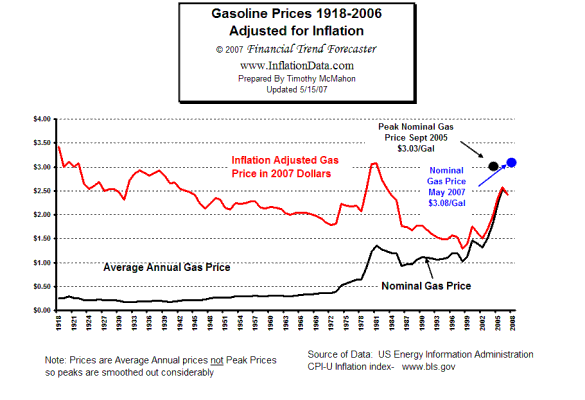
Inflation Adjusted Gas Prices

This chart, from www.InflationData.com , shows the inflation adjusted average annual gas price since the 1920's. What is interesting is the general downward trend since 1920 in the inflation adjusted price, with the exception of the oil embargo of the 1970's and the recent run-up. If the current bump smooths out, according to this trend line we should land somewhere between $2.00/gal in a few years. Or so I hope!

Saturday, May 19, 2007

Shopping the Competition--At The Dealer?

Mark Tapscott comments on his blog about how GM is suggesting to Chevrolet dealers to rent a Toyota Camry to show next to the new Malibu.

Wow, that's ballsy. Good for GM. It could backfire, though--"Look, honey, the Camry has a much nicer..."

Ford was already doing the "taste test" ads where people supposedly like the Fusion better than the Camry or Accord... but putting the competition's car in the showroom takes it to a new level.

Tapscott wants them to go even further, and allow test drives of the main competition, like that insurance company that offers to let you shop the competition on their web site.

I'd be very surprised if that happened. Not just for cost or liability reasons, but what about credibility? Think of how this could be abused--the Chevy dealer could secretly sabotage the Camry, introducing squeeks and rattles, or knocking out the highest gear on the transmission to increase engine noise. If you had a bad Camry experience at a Chevy dealer, would you trust it?