Here is a little movie for the Mustang fanatics, courtesy of Blue Oval News. It shows Carol Shelby flogging a GT500 prototype at Ford's Dearborn Proving Grounds. The video resolution is poor, but be sure to listen to the sounds.
You may notice a big red button sticking out of the center console above the radio. That is an emergency button, which will kill the engine. These are sometimes installed in prototype vehicles, in case the "drive-by-wire" electronic throttle fails.

Carrying Saleen wheels and Bullitt wheels.
Wednesday, May 18, 2005


Tuesday, May 17, 2005
My Mustang GT Review (Power Corrupts...)
I had the chance to take a friend's brand new Mustang GT manual on a drive today. A bright red specimen, with retro wheels, and the cheapest trim level available. Here are a few observations.
The car looks great. I'm not a fan of retro styling, especially on interiors, but the outside of the car is great. The car has a huge hood, hinting at the power underneath, and a sharkey maw up front. The wheels are far forward, and the sheet metal is wrapped tight around the sides, the car looks fast standing still. Anyone would look good sitting in this car.
I'm not a fan of spoilers, though, and if I bought one of these I would check off the "spoiler delete" option at the dealership. A well designed car like this doesn't need a spoiler to look quick. All the fake ones do is add wind resistance and cost, and reduce your rearward view.
The interior is functional, and neatly assembled, but not rich looking. Some of the pieces look and feel light weight, rental car cheap, but they are put together tightly. There aren't any large gaps or ugly seams. The steering wheel is shaped like an old school 3-spoke wheel, but it is actually a firm foam rubber like material, with a very nice, grippy texture. Cruise control buttons are on the inside top spokes, but I was disappointed that there were no wheel mounted radio controls. The seats are covered with a pronouncedly textured fabric, which is also quite grippy. The seat back had a nice pattern of galloping mustangs on the fabric. The dashboard trim was simple black textured plastic, with a little shiny chrome-like trim around deep gauge wells and the air outlets. The door panels were hard plastic, but nicely textured, with smooth inserts.
Ergonomics are very good. The previous Mustang was apparently designed for apes (...by apes?), in that tall people could not easily reach the steering wheel or the shifter without tilting the seat way back, like a lazy-boy. Only if you had short legs and unnaturally long arms could you sit upright. On this car, I had no problem finding a good seating position. The pedals are arranged so that you can heel-toe shift if you want to.
There was not much of a dead pedal, which is a crime. There should be a nice rubber pad, at least, not a skinny bump in the carpet.
The cup holders need to be offset by about 1" towards the passenger, in the center console, to avoid interfering with the drivers arm if a drink is present.
The rear seats are nearly useless. If a 6' tall adult is driving, I don't see how an adult can sit behind, there is maybe 4" of clearance for legs. Mabye Ford should just do away with the farce, and put an un-cushioned storage area back there.
The stock radio is average--not great sounding, but not awful. Unlike many cars today, it is not integrated into the console, so it can be upgraded easily (Crutchfield!). It has a speed sensitive volume adjustment, which is a nice feature, especially in this car. The other controls are easy to reach, smooth operating, but plasticky.
The driving dynamics are very good, compared to the previous Mustang. The body seems very stiff, with very little vibration and no rattles on potholes and speedbumps. The car seems very composed and solid, although it feels a little heavy to me. The steering is nicely weighted, with a good amount of road feel coming through. There is very little wallow, and the noise points smoothly and quickly when you make sharp adjustments. You can tell that you have a solid rear axle, when you hit bad pavement the rear end skitters sideways a little, but on smooth pavement it doesn't not seem to matter much.
There is lots of noise at highway speeds. Lots of road surface and some wind come through loud and clear, I would get tired of the racket on long highway trips. There is also the engine, which never lets you forget that you have nearly 5L of V8 sitting a few inches in front of your feet. If you turn off the radio, you can hear lots of mechanical music coming from the V8, as well as a little gear whine from the transmission. You also feel the engine loud and clear, through the steering wheel, pedals, and especially the shifter. The overall effect isn't that you are driving a cheap, unrefined car, but that you are connected to a powerful machine through your right hand.
The power band on the Mustang is addictive. Especially for those of us who drive Volvos every day with less than 200HP. Bored? Slide into the clear lane, clutch-in-throttle-blip-downshift, wind it up to 4000RPM, listen to the engine howl in the bass register. You are pushed back into your seat, and before you know it, you are going 80MPH on Woodward Avenue, which is a 45MPH road. That's when you discover the brakes, which are excellent. Linear, nicely weighted like the steering, lots of stopping power.
The Mustang is not a European sports coupe. It drives and idles more like a tightened up old-school muscle car. It is obvious where Ford chose to invest its money in the Mustang, and I think they chose wisely. They spent money on the parts that make car drive well, go fast, turn tight, stop short, and look great on the outside. I don't think I personally would buy one, if I only can have one car, for practicality and comfort reasons, but I would borrow one every chance I got.
Now, if I can just borrow a Corvette for a few hours...
The car looks great. I'm not a fan of retro styling, especially on interiors, but the outside of the car is great. The car has a huge hood, hinting at the power underneath, and a sharkey maw up front. The wheels are far forward, and the sheet metal is wrapped tight around the sides, the car looks fast standing still. Anyone would look good sitting in this car.
I'm not a fan of spoilers, though, and if I bought one of these I would check off the "spoiler delete" option at the dealership. A well designed car like this doesn't need a spoiler to look quick. All the fake ones do is add wind resistance and cost, and reduce your rearward view.
The interior is functional, and neatly assembled, but not rich looking. Some of the pieces look and feel light weight, rental car cheap, but they are put together tightly. There aren't any large gaps or ugly seams. The steering wheel is shaped like an old school 3-spoke wheel, but it is actually a firm foam rubber like material, with a very nice, grippy texture. Cruise control buttons are on the inside top spokes, but I was disappointed that there were no wheel mounted radio controls. The seats are covered with a pronouncedly textured fabric, which is also quite grippy. The seat back had a nice pattern of galloping mustangs on the fabric. The dashboard trim was simple black textured plastic, with a little shiny chrome-like trim around deep gauge wells and the air outlets. The door panels were hard plastic, but nicely textured, with smooth inserts.
Ergonomics are very good. The previous Mustang was apparently designed for apes (...by apes?), in that tall people could not easily reach the steering wheel or the shifter without tilting the seat way back, like a lazy-boy. Only if you had short legs and unnaturally long arms could you sit upright. On this car, I had no problem finding a good seating position. The pedals are arranged so that you can heel-toe shift if you want to.
There was not much of a dead pedal, which is a crime. There should be a nice rubber pad, at least, not a skinny bump in the carpet.
The cup holders need to be offset by about 1" towards the passenger, in the center console, to avoid interfering with the drivers arm if a drink is present.
The rear seats are nearly useless. If a 6' tall adult is driving, I don't see how an adult can sit behind, there is maybe 4" of clearance for legs. Mabye Ford should just do away with the farce, and put an un-cushioned storage area back there.
The stock radio is average--not great sounding, but not awful. Unlike many cars today, it is not integrated into the console, so it can be upgraded easily (Crutchfield!). It has a speed sensitive volume adjustment, which is a nice feature, especially in this car. The other controls are easy to reach, smooth operating, but plasticky.
The driving dynamics are very good, compared to the previous Mustang. The body seems very stiff, with very little vibration and no rattles on potholes and speedbumps. The car seems very composed and solid, although it feels a little heavy to me. The steering is nicely weighted, with a good amount of road feel coming through. There is very little wallow, and the noise points smoothly and quickly when you make sharp adjustments. You can tell that you have a solid rear axle, when you hit bad pavement the rear end skitters sideways a little, but on smooth pavement it doesn't not seem to matter much.
There is lots of noise at highway speeds. Lots of road surface and some wind come through loud and clear, I would get tired of the racket on long highway trips. There is also the engine, which never lets you forget that you have nearly 5L of V8 sitting a few inches in front of your feet. If you turn off the radio, you can hear lots of mechanical music coming from the V8, as well as a little gear whine from the transmission. You also feel the engine loud and clear, through the steering wheel, pedals, and especially the shifter. The overall effect isn't that you are driving a cheap, unrefined car, but that you are connected to a powerful machine through your right hand.
The power band on the Mustang is addictive. Especially for those of us who drive Volvos every day with less than 200HP. Bored? Slide into the clear lane, clutch-in-throttle-blip-downshift, wind it up to 4000RPM, listen to the engine howl in the bass register. You are pushed back into your seat, and before you know it, you are going 80MPH on Woodward Avenue, which is a 45MPH road. That's when you discover the brakes, which are excellent. Linear, nicely weighted like the steering, lots of stopping power.
The Mustang is not a European sports coupe. It drives and idles more like a tightened up old-school muscle car. It is obvious where Ford chose to invest its money in the Mustang, and I think they chose wisely. They spent money on the parts that make car drive well, go fast, turn tight, stop short, and look great on the outside. I don't think I personally would buy one, if I only can have one car, for practicality and comfort reasons, but I would borrow one every chance I got.
Now, if I can just borrow a Corvette for a few hours...
Monday, May 16, 2005
Forbes: Big 2 Underrated
Steve Forbes, in the May 23rd issue of his magazine, writes that Ford and GM are underrated, financially. He argues that better products are coming, and that the balance sheets are not bad.
So far, I am with him. The media, and certain web pundits, hammer on F and GM incessantly, as if they are stuck in a loop. It is nearly obsessive-compulsive, the frequency of criticism from all directions. Enough to make a guy like Bob Lutz lash out at the media.
However, when Forbes gets to the practical advice on how to handle the huge cost disadvantage of the American automakers, he loses his marbles, a little.
The UAW will never agree to HSAs. They would have to turn their backs on decades of labor paternalism. The union promise to their people is this: "join our union, keep us in power, pay your dues, and we'll make sure you are taken care of". HSAs would no doubt work, by causing people to consume less healthcare, since some of the cost will come directly out of their accounts. However, in an HSA, the user has to manage the billing himself, even negotiating prices with doctors. I just don't see the UAW going for it--and I don't blame them.
A 401(k) like retirement account for auto workers is a little more likely, but they probably won't offer much choice for the worker. From the UAW web site:
And even if the UAW agreed to change to individual retirement accounts instead of a traditional pension plan, the companies would still have to keep paying existing retirees. There is no way around the problems of a shrinking company.
The woes of the U.S. automotive industry have been well covered by the media. The problems are all too real, but the negativity has been overdone.
...
Ford Motor Co.'s common stock and its income securities have been way overhammered by the fallout from General Motors' well-publicized woes. If Ford is an example of a large, sick company, may there be more of them. Ford will make money this year. More important, its cash flow is positive. That is something to emphasize: Ford will take in more cash than it spends--this in a year that'll be pretty tough for auto manufacturers. The company already sits atop more than $23 billion in cash--that's more than $12 a share. Debt? The obligations of Ford's financial arm are well covered by the stream of payments from auto buyers. The automotive part of the company has debt of $17 billion, and maturities are prudently stretched out for years to come.
Make no mistake, under Bill Ford's leadership future designs of Ford vehicles will be exciting, cutting-edge, à la the brisk-selling Mustang and the GT sports car.
...
General Motors? If management does for the rest of GM what it did for once-tired Cadillac, then GM is in for sunnier days.
So far, I am with him. The media, and certain web pundits, hammer on F and GM incessantly, as if they are stuck in a loop. It is nearly obsessive-compulsive, the frequency of criticism from all directions. Enough to make a guy like Bob Lutz lash out at the media.
However, when Forbes gets to the practical advice on how to handle the huge cost disadvantage of the American automakers, he loses his marbles, a little.
I have a great deal of respect for Steve Forbes, however, I think he must have been drinking Michael Jackson's cool-aid. HSAs? Personal retirement accounts? For the UAW?!?
What about Detroit's onerous health care and pension obligations? The answer is for unionized workers to switch over to Health Savings Accounts (HSAs). They'd still enjoy catastrophic coverage, and much of their high deductibles would be covered by cash payments to their individual tax-free accounts. Auto manufacturers would save a bundle on healthcare premiums, and most workers would see HSAs as a positive step up from their current plans: If a worker is blessed with good health, he would build up a nice pile of cash that belonged to him. A variation on HSAs could be offered to retired workers.
The United Auto Workers will fiercely resist such a change--initially. There may even be labor strife before the union accedes. But leaders and members know in their gut that the current situation is untenable. With an HSA-type solution they'd get as much of a win/win situation as is possible under the circumstances.
As for pensions, a bit of improvement in the financial markets will provide enormous relief. Longer term--after the introduction of HSAs--the next battle will be to get 401(k)-like plans for new unionized factory workers.
The UAW will never agree to HSAs. They would have to turn their backs on decades of labor paternalism. The union promise to their people is this: "join our union, keep us in power, pay your dues, and we'll make sure you are taken care of". HSAs would no doubt work, by causing people to consume less healthcare, since some of the cost will come directly out of their accounts. However, in an HSA, the user has to manage the billing himself, even negotiating prices with doctors. I just don't see the UAW going for it--and I don't blame them.
A 401(k) like retirement account for auto workers is a little more likely, but they probably won't offer much choice for the worker. From the UAW web site:
The UAW believes that 401(k) plans can provide a valuable supplement to defined benefit plans. But, as vividly demonstrated by the Enron and WorldCom debacles, these plans provide less retirement security for working families. Workers are not guaranteed any specific benefits under 401(k) plans. Instead, the benefits are subject to the risks of stock market fluctuations and may turn out to be illusory. Significantly, the PBGC does not guarantee benefits under 401(k) plans.
To prevent a recurrence of the Enron and WorldCom abuses, the UAW believes there is a need for reforms... to ensure that there is prudent diversification of plan investments by participants in 401(k) plans.
And even if the UAW agreed to change to individual retirement accounts instead of a traditional pension plan, the companies would still have to keep paying existing retirees. There is no way around the problems of a shrinking company.
Some People Like Retro
James Lileks, for example (HT: Joe Sherlock):
I think that Cadillac has a much better idea: drag people kicking and screaming into a new design theme, something edgy and different. When you see a Cadillac drive by, now, you know that it is a Cadillac, not some creased jellybean that might be a Lexus, Infiniti, Toyota, Honda, or Hyundai. It may alienate some of the older customers, that is true. But let them put their vinyl roofs on Towncars.
Today we went through many web pages looking at many cars, and it was depressing; most mid-priced sedans were designed by graduates of the International Institute of Boring Your Ass Off, and have the same dull front and the same dull back and the same dull middle. I repeat my earlier contention: bring back a car that would have looked at home in 1957 and they would sell a kajillion units. Something that leaned into the wind, had boobie headlights and forty-nine tons of chrome, two colors, poke-your-eye-out fins and a hood ornament in the shape of a rocket or a nuclear weapon. But no: we get the same old same old, over and over.Not me. Except for maybe the 2005 Mustang, I don't get much out of retro-styled cars like the Chrysler PT Cruiser or the Chevrolet HHR. I guess I'm too young, and I don't have any nostalgia for the pop culture of the 1950's. Fins on cars look silly, and so does too much chrome.
I think that Cadillac has a much better idea: drag people kicking and screaming into a new design theme, something edgy and different. When you see a Cadillac drive by, now, you know that it is a Cadillac, not some creased jellybean that might be a Lexus, Infiniti, Toyota, Honda, or Hyundai. It may alienate some of the older customers, that is true. But let them put their vinyl roofs on Towncars.
GM Kills V10
According to a post in GMInsidenews (HT: Angry Engineer), GM is stopping work on a pushrod V10 engine that was supposed to be an even higher performance motor than the large V8's they sell.
500HP is not too shabby, even if it is pushing a full sized "sport truck". Anyone who drives such a thing can afford the premium gas. GM will not fall behind the pack with this decision.
GMInsidenews has learned that the highly anticipated LS derived V10 slated for production in several upcoming GM vehicles has been terminated. According to GM insiders, the V10 was scrapped due to fears of fuel consumption and the redundancy of its power output compared to the Supercharged 6.0L LS2. Apparently after being tuned, a Supercharged LS2 is capable of up to 608HP. However it is more likely that GM will send out its Supercharged LS2 with a 500HP/500lb.ft torque rating. While the V10 would not have required premium fuel (as does the LS2 SC), it's ratings would be lower than that of the LS2 SC, while retaining the same power numbers.This probably has a lot in common with Ford's recent decision to kill their 6L V8 project. Why spend money on engineering and tooling for larger displacement engines, when tougher CAFE and emissions standards are coming? Much better to refine the engines that you have, and spend your cash on quality, safety, and comfort.
500HP is not too shabby, even if it is pushing a full sized "sport truck". Anyone who drives such a thing can afford the premium gas. GM will not fall behind the pack with this decision.
Sunday, May 15, 2005
Carnival of Cars #1
(For the first try, these are just the car blog posts that I liked. In the future, maybe people could suggest which posts they thought where their best. Time permitting, I will try to do this again every week or two, unless someone else would like to volunteer to host it.)
Welcome InstaPundit readers! Thanks Glenn!
So, without further delay, step right up ladies and gentlemen, to the Carnival of Cars. And don't mind the carnies, they are tattooed but tame.
Welcome InstaPundit readers! Thanks Glenn!
So, without further delay, step right up ladies and gentlemen, to the Carnival of Cars. And don't mind the carnies, they are tattooed but tame.
- AutoBlog reports that some roll-out plans for the new Ford 3.5L V6 "Duratec 35" have been leaked. Apparently, in 2007 the Fusion/Milan/Zephyr get it, and in 2008 the 500/Montego/Freestyle.
- AutoMuse muses on the dangers of "clipping" t ype collision repairs, where whole sections of a vehicles unibody are cut off, and new sections are welded on in their place. As AutoMuse points out, this repair may look right, but it may not be safe.
- AutoProphet spots a mysterious Mustang prototype, which looks like the next Mach 1. Unfortunately, no camera.
- BigFordFan ponders whether the automakers get their moneys worth out of Nascar. Apparently an iconoclast, BFF declares that Nascar isn't worth sponsoring, and that carmakers should focus on the autosports that run actual production or near-production vehicles.
- Carpundit continues his crusade for seat belts on school buses, blogging about a severe school bus crash in Missouri.
- Bob at Cars! Cars! Cars! predicts GM and Ford will have to merge to survive, in his predicted list of the top 7 carmakers 10 years from now.
- Dublin Saab delivers a brutal debunking to 40mpg.org over their middle-east oil consumption calculator. Apparently, the calculator doesn't take into account the fact that not all our oil is imported from the middle east. Dublin also discusses the non-intuitive economic results if oil prices drop. Reduced consumption, so the high volume producers (Saudi Arabia, etc.) will be in a better position to survive than the smaller producers. Effect: more middle-east oil consumption, relative to other sources.
- The scrappy Bob Lutz of Fastlane, in a daring move, gives away GM's secret plans for fixing its problems: build better cars, and sell more of them.
- Gary Wirtzenburg spars with Robert Farago on The Truth About Cars over GM's chances. Farago is in death-watch mode, while Wirtzenburg tells him he needs a fact checker. Ouch.
- Grant's Autorants scolds scrappy Bob Lutz for blunt public comments which may sound foolish: that well-off people who buy SUVs don't care if gas is expensive.
- Dave at Just Auto delivers a rumor that Ford is talking to Nissan in Europe about some kind of joint venture.
- NextGenAuto blogs about the media's too quick assumption that because Toyota apparently offered to sell GM hybrid technology, and because GM's management was going to meet with Toyota management, that they were in fact going to discuss the deal. Which was not the case.
- The Angry Engineer (aren't we all?) points out how the credit downgrades of GM and Ford is snowballing, doing damage to the ability of suppliers to borrow against accounts receivable from the OEMs.
- Peter at The Auto Extremist lists his ten hottest automotive stories for 2005: the future of GM; the implosion of Detroit; the dark side of Toyota; Chrysler's shallow success; Hyundai's ascent; Hybrid over-hype; Honda's lagging; Nissan's momentum; BMW's missteps; VW's woes.
- Joe Sherlock needs to add bookmarks to his posts so I can link to them. On May 10th, Joe posts about the Detroit Free Press columnist who decides to buy a Honda Accord, and gets inundated with hate mail from irate readers. Joe bought an Avalon, so we should all be sending him hate mail as well.
Friday, May 13, 2005
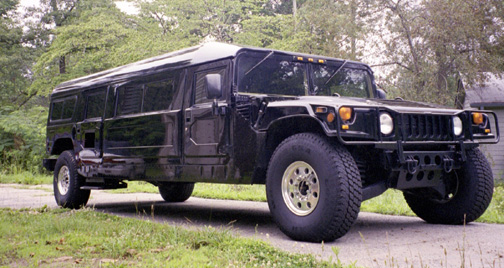
Jumbo Mini Prom-Mobile
"Understated elegance"...

...overstated intelligence.
What next? A Miata limo? Maybe a stretch motorcycle?
Update:
Oops, found one. Good for that Sturgis wedding...

Wright Brothers Anaconda
Update:
And, of course, few things are as luxurious as a coach made from a 4WD diesel powered military truck.
Maximum Limousine Inc.
...overstated intelligence.
What next? A Miata limo? Maybe a stretch motorcycle?
Update:
Oops, found one. Good for that Sturgis wedding...
Wright Brothers Anaconda
Update:
And, of course, few things are as luxurious as a coach made from a 4WD diesel powered military truck.
Maximum Limousine Inc.
Thursday, May 12, 2005
The CAW Posture
I heard an interesting interview of the Canadian Auto Worker's president, Buzz Hargrove, on the Paul W. Smith show on WJR this morning. Hargove was invited to explain his recent comments that the CAW had no intention of conceding benefits to the American automakers. Memorable quotes (approximate, from memory):
"We could work for free" was a great redirection, and about 1/4th true. The average car takes about 24 man-hours to build. The average unionized worker is paid something on the order of $25/hr. So the labor cost per vehicle is about $625. However, the "legacy cost" per vehicle is on the order of $2100--GM spends $1500 on healthcare and $600 on pensions, averaged over all of their production volume.
By comparison, the Japanese automakers probably do pay a few dollars less per hour, and use less hours to build each car, closer to 19. That would account for a disadvantage of, say, $30/car. The big ticket items are the pension and healthcare costs--Toyota, according to one article I read, only spends about $300/car on healthcare. and about $200/car for pensions, leaving GM with a cost disadvantage of $1600/car.
That $1600/car is the killer, because that is $1600 that was not used to improve quality, safety, fuel economy, or pay for incentives. Consider: the difference in (street) price between an aluminum block DOHC engine and an iron block OHV engine is about $900 (2005 Taurus example, from Edmund's).
So, Buzz is right--they could work for free, in terms of wages, and only save GM or Ford about $600, 1/4th of the competitive disadvantage with the Japanese. The Canadian Auto Workers probably don't have much to offer GM and Ford, compared to their much larger counterpart in the US--they are a much smaller union, with about 50,000 members working for OEMs vs UAW's 300,000. But if the UAW would agree to some concessions, that could really help the Big 2.5 gain competitiveness.
"The issue is market share..." I don't agree with this entirely. It is true that much of the increase in legacy costs per vehicle is simply due to selling fewer vehicles. Just like the Social Security problems--too many retirees compared to productive workers. But blaming market share is not much of an answer, because market share is virtually impossible to regain quickly, especially when the American companies are working with a large cost disadvantage.
"Malcom Bricklin..." is a very good observation. I am not a fan of trade wars, we need people to buy our stuff. But should it be easy for Bricklin to dump his cheap Chinese cars in the US market? Is the danger of massive economic destruction of a major domestic industry worth a few inexpensive cars, to the average consumer? Ronald Reagan's import tariffs on Japanese motorcycles are credited with saving Harley Davidson.
"Chrysler is doing well now..." I have written before, in my opinion, Chrysler is always one hit away from disaster, but somehow, they manage to come up with the right products at the last moment. Hopefully they will be more of an influence on Mercedes than Mercedes on them.
Hargove's bluster is natural--his job is to represent his workers, not sell them out in public. However, conceding some goodies would definetely help the auto companies. It would free up money that could be put back into the product, to try to increase prices and profitability. The CAW and UAW need to be carefull, and balance their members individual needs against the survival of the industry.
We could work for free, it would not save the auto companies.
The issue is market share. Taking money out of the pockets of working people will not save them.
Malcolm Bricklin is over in Shanghai, talking about bringing 200,000 cars into the U.S. He's just over the water from Japan.. why isn't he going to import cars into Japan? Because the Japanese won't let him. Why will the U.S. let him import cars, and destroy such an important industry?
Chrysler is doing well now, but it is not sustainable. They have a few hits, the 300, the Jeeps are doing well, the minivans. But they can't gain market share.
"We could work for free" was a great redirection, and about 1/4th true. The average car takes about 24 man-hours to build. The average unionized worker is paid something on the order of $25/hr. So the labor cost per vehicle is about $625. However, the "legacy cost" per vehicle is on the order of $2100--GM spends $1500 on healthcare and $600 on pensions, averaged over all of their production volume.
By comparison, the Japanese automakers probably do pay a few dollars less per hour, and use less hours to build each car, closer to 19. That would account for a disadvantage of, say, $30/car. The big ticket items are the pension and healthcare costs--Toyota, according to one article I read, only spends about $300/car on healthcare. and about $200/car for pensions, leaving GM with a cost disadvantage of $1600/car.
That $1600/car is the killer, because that is $1600 that was not used to improve quality, safety, fuel economy, or pay for incentives. Consider: the difference in (street) price between an aluminum block DOHC engine and an iron block OHV engine is about $900 (2005 Taurus example, from Edmund's).
So, Buzz is right--they could work for free, in terms of wages, and only save GM or Ford about $600, 1/4th of the competitive disadvantage with the Japanese. The Canadian Auto Workers probably don't have much to offer GM and Ford, compared to their much larger counterpart in the US--they are a much smaller union, with about 50,000 members working for OEMs vs UAW's 300,000. But if the UAW would agree to some concessions, that could really help the Big 2.5 gain competitiveness.
"The issue is market share..." I don't agree with this entirely. It is true that much of the increase in legacy costs per vehicle is simply due to selling fewer vehicles. Just like the Social Security problems--too many retirees compared to productive workers. But blaming market share is not much of an answer, because market share is virtually impossible to regain quickly, especially when the American companies are working with a large cost disadvantage.
"Malcom Bricklin..." is a very good observation. I am not a fan of trade wars, we need people to buy our stuff. But should it be easy for Bricklin to dump his cheap Chinese cars in the US market? Is the danger of massive economic destruction of a major domestic industry worth a few inexpensive cars, to the average consumer? Ronald Reagan's import tariffs on Japanese motorcycles are credited with saving Harley Davidson.
"Chrysler is doing well now..." I have written before, in my opinion, Chrysler is always one hit away from disaster, but somehow, they manage to come up with the right products at the last moment. Hopefully they will be more of an influence on Mercedes than Mercedes on them.
Hargove's bluster is natural--his job is to represent his workers, not sell them out in public. However, conceding some goodies would definetely help the auto companies. It would free up money that could be put back into the product, to try to increase prices and profitability. The CAW and UAW need to be carefull, and balance their members individual needs against the survival of the industry.
Batman Called...
...and he wants his car back.
This is a picture of the Maybach Exelero concept (HT: Autoblog)

I think it looks very... Teutonic. Kind of a cross-breed between a new BMW and a Chrysler Crossfire.
This is a picture of the Maybach Exelero concept (HT: Autoblog)
I think it looks very... Teutonic. Kind of a cross-breed between a new BMW and a Chrysler Crossfire.
Ramming the Iceberg
From the Detroit News, a report that GM is going to increase production at its full size truck plants, "in anticipation of a surge in late spring and summer sales."
This is quite a gamble. If the sales jump doesn't materialize, GM will be left with even more inventory languishing on storage lots, and will have to put even more cash on the hood to sell it all off. Currently, GM has an 80 day supply of its trucks.
GM apparently continues to embrace the "volume at all costs" strategy, but they really don't have much of a choice at this point. They have spoiled their customers with rebates, and the new trucks are not due for some time yet.
This is quite a gamble. If the sales jump doesn't materialize, GM will be left with even more inventory languishing on storage lots, and will have to put even more cash on the hood to sell it all off. Currently, GM has an 80 day supply of its trucks.
GM apparently continues to embrace the "volume at all costs" strategy, but they really don't have much of a choice at this point. They have spoiled their customers with rebates, and the new trucks are not due for some time yet.
Wednesday, May 11, 2005
New Mach 1?
Today while driving in to work, I saw a bright red M-plate (manufacturers plate) 2005 Mustang GT, with a functional "shaker" type hood scoop, mounted to the engine and protruding through the hood. I wish I had a camera handy, but I didn't. It was not a hack job, but an apparently finished part, so I am guessing it is well along in development. No other major changes were apparent.
So it looks like there is a Mach 1 version of the new Mustang coming soon.
So it looks like there is a Mach 1 version of the new Mustang coming soon.
Price Gouging
Some shoppers get upset when a dealer adds a "market adjustment" to the MSRP of a hot new car, such as the Toyota Prius or Ford GT. I don't see a problem with it--it isn't "gouging", it is basic economics. The price of something will go up as long as someone is willing to pay more, until demand recedes and balances against the supply of the product, or the amount of product increases and balances the demand. Early adopters pay handsomely for the chance.
Here is an interesting web page, put up to explain the pricing environment for the Ford GT: www.fordgtprices.com. Currently, dealers are marking up the sticker price by as much as $45,000. However, the web page believes that the prices will fall at a rate of about $25,000/quarter, based on the first 244 cars sold, and that the prices will decay until they are nearly at MSRP. (I'm bummed that this is, for me, an academic topic!)
For the Prius example, this article states that 7% of Prius buyers paid more than MSRP, and 68% paid no more than MSRP. That tells me that 68% of Prius buyers are firmly committed environmentalists, and 7% of them are greenie wingnuts. But comfortably middle class ones.
Here is an interesting web page, put up to explain the pricing environment for the Ford GT: www.fordgtprices.com. Currently, dealers are marking up the sticker price by as much as $45,000. However, the web page believes that the prices will fall at a rate of about $25,000/quarter, based on the first 244 cars sold, and that the prices will decay until they are nearly at MSRP. (I'm bummed that this is, for me, an academic topic!)
For the Prius example, this article states that 7% of Prius buyers paid more than MSRP, and 68% paid no more than MSRP. That tells me that 68% of Prius buyers are firmly committed environmentalists, and 7% of them are greenie wingnuts. But comfortably middle class ones.
Tuesday, May 10, 2005
NHTSA Shoots Down Fire Extinguisher Industry
Autoblog has an item about how NHTSA has denied a request from the Fire Equipment Manufacturers Association (news story here). The FEMA (not to be confused with Federal Emergency Management Administration) petitioned NHTSA to require portable fire extinguishers on vehicles weighing less than 10,000lbs. Vehicles that weight more than 10,000lbs are currently required to carry fire extinguishers on-board.
They also require drivers who have commercial Drivers Licenses, since these large vehicles are busses, tractor trailers, construction machines, etc. Commercial drivers are trained, at least in the basics, of fire safety. The Michigan CDL Manual , for example, has a chapter on how to handle vehicle fires.
NHTSA was right to reject the petition. Without some way to ensure that people get fire training, requiring fire extinguishers would be wasteful at best and dangerous at worst, if people try to fight a fire they should be fleeing. This looks like an attempt to enlarge the market for fire extinguishers. What FEMA should do is to sponsor a nationwide advertising campaign, encouraging drivers to buy fire extinguishers for their cars, and to offer training on how to use them. It could be very effective, if it showed examples, like OnStar, of how a fire extinguisher carried in a vehicle saved lives or property.
I personally do carry fire extinguishers in all of my cars, along with the flares, jumper cables, etc. I have never had to use the fire extinguisher, but is a nice bit of insurance.
They also require drivers who have commercial Drivers Licenses, since these large vehicles are busses, tractor trailers, construction machines, etc. Commercial drivers are trained, at least in the basics, of fire safety. The Michigan CDL Manual , for example, has a chapter on how to handle vehicle fires.
NHTSA was right to reject the petition. Without some way to ensure that people get fire training, requiring fire extinguishers would be wasteful at best and dangerous at worst, if people try to fight a fire they should be fleeing. This looks like an attempt to enlarge the market for fire extinguishers. What FEMA should do is to sponsor a nationwide advertising campaign, encouraging drivers to buy fire extinguishers for their cars, and to offer training on how to use them. It could be very effective, if it showed examples, like OnStar, of how a fire extinguisher carried in a vehicle saved lives or property.
I personally do carry fire extinguishers in all of my cars, along with the flares, jumper cables, etc. I have never had to use the fire extinguisher, but is a nice bit of insurance.
They Are Listening
Here is a good reason to blog: the automakers are monitoring the enthusiast forums and blogs, looking for feedback, buzz, and mis-information that needs to be countered.
If enough of us complain about the same things, or request the same things, we may influence what the automakers do. (I suggest postings requesting more manual transmission V6 vehicles.)
So go ahead and post the rant! Maybe it will make an impression.
If enough of us complain about the same things, or request the same things, we may influence what the automakers do. (I suggest postings requesting more manual transmission V6 vehicles.)
So go ahead and post the rant! Maybe it will make an impression.
Monday, May 09, 2005
Putin's Ride
When foreign leaders visit George W. Bush at his ranch in Crawford, TX, he takes them on a ride in his F250.
When foreign leaders visit Vladimir Putin, he takes them for a ride in his... Volga?

Actually, this is oddly appropriate: the GAZ (Gorky Auto Factory) was a joint venture between Ford and the USSR in the 1920's (see Wikipedia)
When foreign leaders visit Vladimir Putin, he takes them for a ride in his... Volga?
Actually, this is oddly appropriate: the GAZ (Gorky Auto Factory) was a joint venture between Ford and the USSR in the 1920's (see Wikipedia)
Polling the Customers
I saw a news item recently that Ford has posted a "build your Fusion" web site (here). What is new about this is that the Fusion is not in production yet--Ford is polling the customers, to see what build combinations are most popular.
My biggest disappointment with the Fusion is that it will not come in a V6 + manual combination. If you want to row your own, you have to buy the 2.3L I-4, which will not be exactly sporty--I would guess 0-60 times in the 9s range. Mazda was caught off guard when many more customers than expected, seeking zoom-zoom, wanted to buy a Mazda6 with a V6 and manual transmission.
Ford has added a "Future Options" screen to the site. They offer a list of possible future equipment, such as AWD, V6 manual, navigation system, stability control, etc.
This is a great idea. All carmakers should set up web sites where potential customers can configure their preferred combination. If they do this well enough in advance, say when a concept is unveiled at an auto show, by the time production comes around, they will have had time to adjust the product.
My biggest disappointment with the Fusion is that it will not come in a V6 + manual combination. If you want to row your own, you have to buy the 2.3L I-4, which will not be exactly sporty--I would guess 0-60 times in the 9s range. Mazda was caught off guard when many more customers than expected, seeking zoom-zoom, wanted to buy a Mazda6 with a V6 and manual transmission.
Ford has added a "Future Options" screen to the site. They offer a list of possible future equipment, such as AWD, V6 manual, navigation system, stability control, etc.
This is a great idea. All carmakers should set up web sites where potential customers can configure their preferred combination. If they do this well enough in advance, say when a concept is unveiled at an auto show, by the time production comes around, they will have had time to adjust the product.
Sunday, May 08, 2005
Blog Ethics: Employers and Employees [Culture]
Aish HaTorah's "The Jewish Ethicist" has a fascinating article on the ethicss of blogging, specifically, if an employer can fire an employee for what the employee blogged about the company. The conclusion:
The article is here.So your first step should be to examine if taking action against this employee is really in your best interest. If the person is a good worker and not doing any material damage to your firm, the best thing is probably to just leave him alone and take advantage of any lessons you can learn from his log.
If you conclude that the worker's words create an unfair image of your firm, then by all means take action. Explain your expectations to the worker, and listen carefully to any counterclaims he may make. If you have given fair warning and the activity continues then you should consider disciplinary action.
Thank You, Vietnam Veterans [Politics]
If anyone reading this blog is a Vietnam Veteran, let me take a moment to say:
Thank you for our service to our country, and may God bless you.
The men who fought against the North Vietnamese, Chinese, and Russian military were no less professional, humanitarian, or courageous than the men who fought against the Wehrmacht, or the men who fought against the Iraqi Republican Guard. They were not "baby killers" or "imperialists". The true baby killers were the North Vietnamese, who would slaughter their own people rather than let them be helped by the U.S. The true imperialists were the Chinese, who wanted to spread communism throughout Asia.
There was no strange moral change in the '60's which created an army of monsters, these were young men from the same decent society that produced the armies of the "greatest generation". The anti-war movement of the 60's was sympathetic to communism, and wanted the U.S. to lose, much like todays fringe anti-war activists want the U.S. to lose in the middle-east. The radicals of the '60s have managed to control the language of history for too long.
Jane Fonda deserved what she recently got.
Thank you for our service to our country, and may God bless you.
The men who fought against the North Vietnamese, Chinese, and Russian military were no less professional, humanitarian, or courageous than the men who fought against the Wehrmacht, or the men who fought against the Iraqi Republican Guard. They were not "baby killers" or "imperialists". The true baby killers were the North Vietnamese, who would slaughter their own people rather than let them be helped by the U.S. The true imperialists were the Chinese, who wanted to spread communism throughout Asia.
There was no strange moral change in the '60's which created an army of monsters, these were young men from the same decent society that produced the armies of the "greatest generation". The anti-war movement of the 60's was sympathetic to communism, and wanted the U.S. to lose, much like todays fringe anti-war activists want the U.S. to lose in the middle-east. The radicals of the '60s have managed to control the language of history for too long.
Jane Fonda deserved what she recently got.
Saturday, May 07, 2005
GMF?
Bob at Cars!Cars!Cars! predicts that GM and Ford will have to merge to survive. This is an interesting idea, and makes a certain amount of sense, from the outside--the last stand of the All-American Manufacturing Giant. However, to pull it off, they would basically have to go bankrupt first. GMF would need to be lean and mean--the combination of GM and Ford's best products, not the combination of their legacy costs and union contracts.
I see another likely merger between Ford and a foreign competitor, such as Honda. Ford would be a good acquisition for a company that wanted to buy its way into the light truck and commercial vehicle market. Honda-Ford would have a lineup of world class compact cars, light trucks, and commercial vehicles. The problem is, how would Honda handle the UAW?
As a side dish, maybe Delphi and Visteon would merge too--Delpheon. Quick, somebody trademark that.
I see another likely merger between Ford and a foreign competitor, such as Honda. Ford would be a good acquisition for a company that wanted to buy its way into the light truck and commercial vehicle market. Honda-Ford would have a lineup of world class compact cars, light trucks, and commercial vehicles. The problem is, how would Honda handle the UAW?
As a side dish, maybe Delphi and Visteon would merge too--Delpheon. Quick, somebody trademark that.
The Hygasm
There is a new blog in town, pumping out all hybrids all the time. A project of the far left Union of Concerned Scientists, a cabal of college professors with leftist tendencies, the HybridBlog's purpose is to advocate hybrids, and also apparently to attack auto manufacturers for not converting to their religion more quickly.
The greenies over at UCS suffer from the usual progressive disorder: they don't understand (don't respect) basic economics. The automakers need to make a profit, to invest in future products. GM can't drop everything and go pump out hybrids, they would go broke. There needs to be demand, and so far the public is not entirely sold. With good reason--hybrids don't pay for themselves based on fuel savings alone, unless there are large tax incentives.
Rather than hammer on the industry, and advocate more government regulation, what UCS should do is to spend their time and money convincing the car buying public to buy hybrids. Convince the middle class families in the suburbs that they ought to be paying $3000 more for their vehicles, because it will purportedly help stop global warming.
In honor of HybridBlog and UCS, I am now coining the term "hygasm" (TM). A hygasm is the wave of elation that passes over an environmentalist when he discusses how great hybrid vehicles are.
The greenies over at UCS suffer from the usual progressive disorder: they don't understand (don't respect) basic economics. The automakers need to make a profit, to invest in future products. GM can't drop everything and go pump out hybrids, they would go broke. There needs to be demand, and so far the public is not entirely sold. With good reason--hybrids don't pay for themselves based on fuel savings alone, unless there are large tax incentives.
Rather than hammer on the industry, and advocate more government regulation, what UCS should do is to spend their time and money convincing the car buying public to buy hybrids. Convince the middle class families in the suburbs that they ought to be paying $3000 more for their vehicles, because it will purportedly help stop global warming.
In honor of HybridBlog and UCS, I am now coining the term "hygasm" (TM). A hygasm is the wave of elation that passes over an environmentalist when he discusses how great hybrid vehicles are.
Subscribe to:
Posts (Atom)